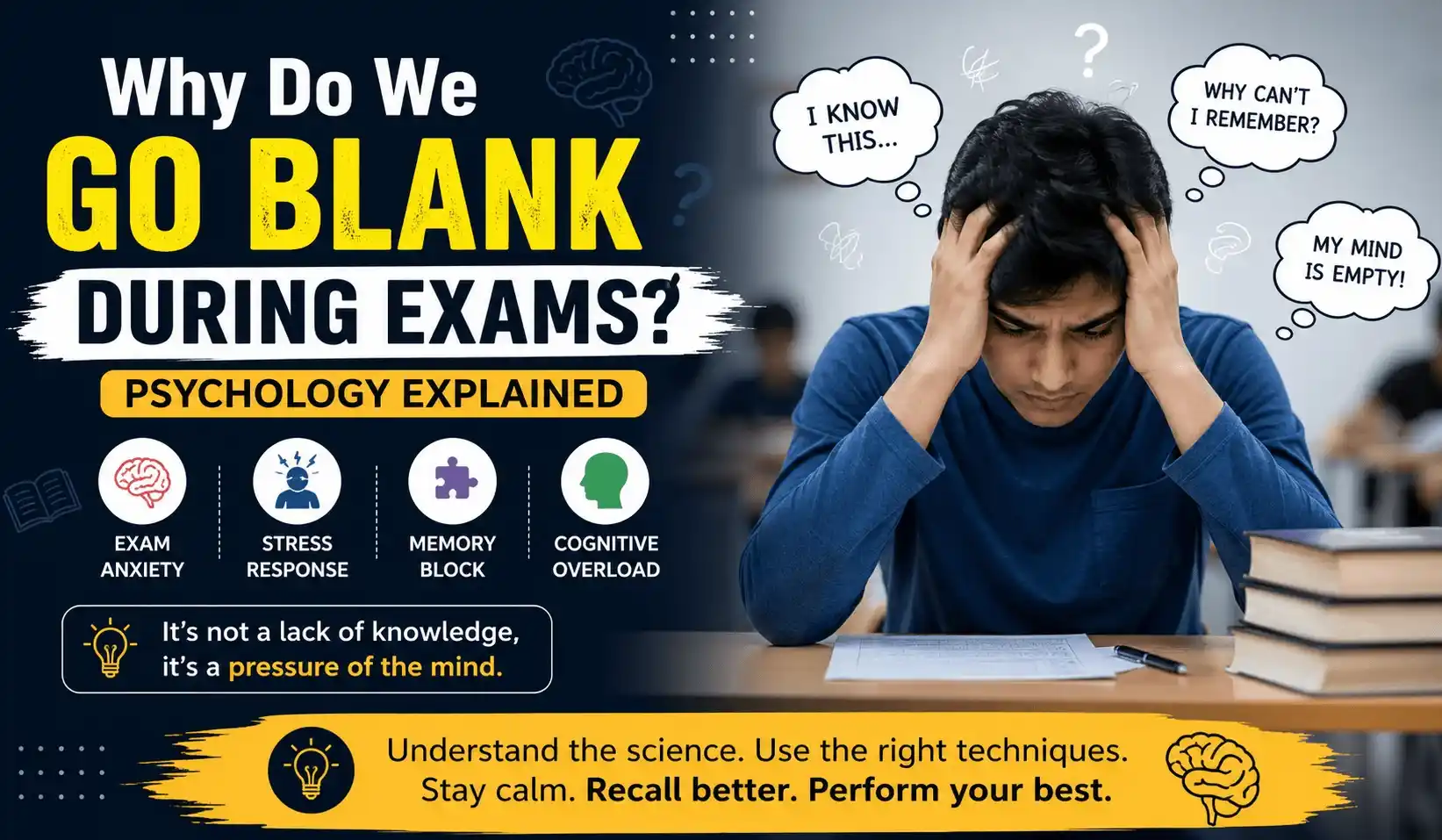
It’s pretty common for students to go blank during exams, where they suddenly can’t remember anything they’ve studied, even if they’ve prepared thoroughly. This phenomenon is often triggered by exam anxiety, stress hormones, and cognitive overload, which can temporarily mess with our ability to retrieve memories.
What Does “Going Blank” During Exams Mean?
“Going blank” is just a fancy way of saying that, under pressure, our memory can take a little vacation.
- You know the answer when you’re studying
- But it slips your mind in the exam room
- You might remember it later once the stress eases
This isn’t about not knowing the material—it’s more about how we perform under pressure, not how well we prepared.
Why Do We Go Blank During Exams?
1. Exam Anxiety and Stress Response
Walking into an exam hall can trigger your brain’s fight-or-flight response.
- Stress hormones like cortisol kick in
- Your heart starts racing
- Your brain shifts from thinking to just surviving
This can throw off the prefrontal cortex, the part of your brain that handles memory and reasoning.
Struggling with exam stress or memory issues?
Master your mind with psychology-based techniques.
Download our app now & start learning smarter!
2. Cognitive Overload
Our brains can only handle so much information at once.
- Too much cramming before the exam
- Trying to juggle all the facts at the same time
- Multitasking while studying
This overload can lead to mental fatigue, making it tough to recall what you’ve learned.
3. Fear of Failure
Thoughts like “What if I fail?” can ramp up anxiety.
- They create self-doubt
- Lower your confidence
- Block those memory retrieval pathways
This creates a vicious cycle of anxiety and forgetting.
4. The Importance of Effective Revision Techniques
Just passively reading won’t do much for your memory.
- No active recall practice
- No spaced repetition
- Lack of clear concepts
Because of this, the information you learn is stored weakly, making it tough to pull up when you really need it.
Want real-world experience in psychology?
Gain practical skills, case exposure, and expert guidance.
🎓 Apply for our Clinical Psychology Internship today!
5. The Impact of Poor Sleep and Fatigue
Getting enough sleep is crucial for solidifying your memories.
- Insufficient sleep hampers recall
- Brain processing slows down
- Your focus and attention wane
This can lead to those frustrating moments when your mind just goes blank.
Liked this blog? We’ve got more for you!
Keep learning with our next article.
📖 Explore More → How Do I Manage Stress as a Psychology Student?
What Happens in Your Brain During These Times?
When stress levels rise, your brain shifts its focus from thinking to survival.
- The amygdala (your emotional center) kicks into overdrive
- The prefrontal cortex (the thinking part) becomes less active
- Memory retrieval can get temporarily blocked
That’s why you might suddenly “forget everything,” even if you’ve studied hard.
How to Avoid Going Blank During Exams
Practical Techniques
- Practice Active Recall: Regularly test yourself
- Use Spaced Repetition: Review material at intervals
- Deep Breathing: Instantly calms your nervous system
- Mock Tests: Mimic exam conditions
- Positive Self-Talk: Swap fear for confidence
Don’t stop here—your learning continues!
📖 Read our next blog can a diploma holder apply for mpsc or upsc
People Also Ask (PAA)
Why does my mind suddenly go blank during exams?
When you’re under high stress and anxiety, your mind can go blank. This triggers the fight-or-flight response, reducing activity in the thinking part of your brain and temporarily blocking memory recall, even if you’ve prepared well.
Is it normal to blank out during exams?
Absolutely! It’s a common experience for many students due to the pressure to perform and fear of failure. It’s a psychological reaction, not a reflection of your intelligence or preparation.
How can I quickly remember answers after going blank?
Take a moment to pause and breathe deeply to calm your mind. Then, try to recall related concepts or keywords. This can help reactivate your memory pathways and improve your recall.
Does anxiety impact memory during exams?
Yes, anxiety can significantly affect your memory. High stress levels increase cortisol, which disrupts memory retrieval and concentration, making it more challenging to remember what you’ve studied.
Conclusion
Going blank during exams is a psychological and biological response to stress, not a lack of intelligence. By understanding how your brain works and using the right techniques, you can improve memory recall, reduce anxiety, and perform better in exams.
👉 If you’re preparing for UPSC/MPSC, mastering these psychological strategies can give you a serious competitive edge.