Introduction :
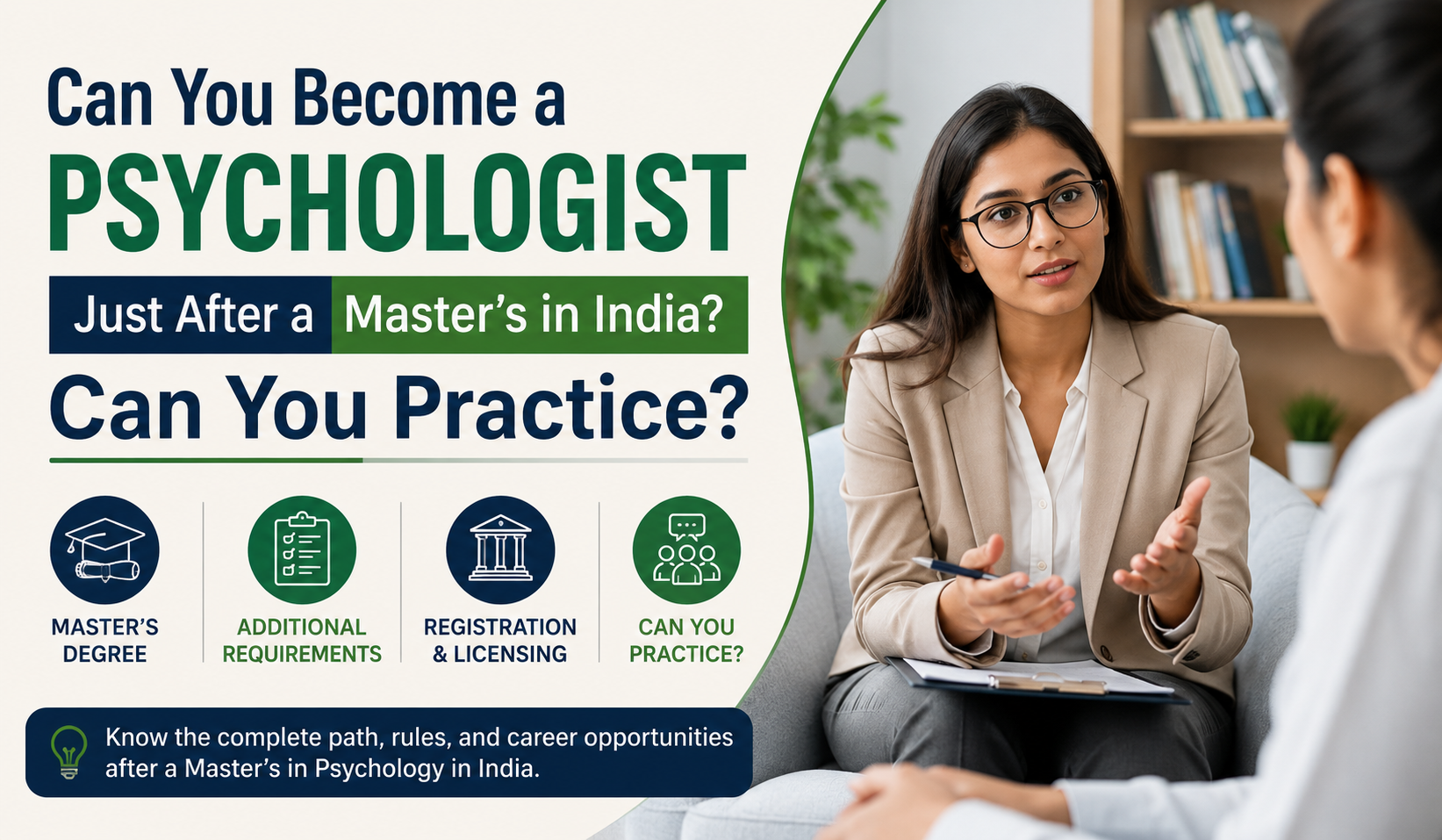
Many psychology students ask the same question: Can you become a psychologist just after a master’s in India? Can you practice? The answer depends on the type of psychology career you want to pursue.
After completing an MA or MSc in Psychology, you can work in several psychology-related roles. However, whether you can practice independently depends on your specialization, qualifications, and the services you intend to provide.
This guide explains the legal position, career options, and what you need to know before starting your professional journey.
Can You Become a Psychologist Just After a Master’s in India?
Yes, you can become a psychologist after completing an MA or MSc in Psychology in India. However, your scope of practice depends on your specialization. You can work in counseling, education, research, HR, and mental wellness. To practice as a Clinical Psychologist, you must complete an M.Phil in Clinical Psychology or an equivalent RCI-recognized qualification under current regulations.
Understanding the Term “Psychologist”
A psychologist is a trained professional who studies human behavior, emotions, cognition, and mental processes. Psychologists may work in education, counseling, research, organizations, rehabilitation, or healthcare settings.
Different psychology specializations have different educational and legal requirements.
Discover Everything You Need to Succeed in Psychology
Whether you’re a student, aspiring psychologist, or civil services aspirant, Confidante Psychology Academy offers expert courses, internships, counselling, and career guidance all in one place.
Can You Practice Psychology After a Master’s in India?
The answer is Yes but with limitations.
An MA or MSc in Psychology qualifies you for many professional opportunities. However, it does not automatically qualify you to practice as a Clinical Psychologist.
Your scope depends on:
- Your specialization
- Your training
- Your workplace
- Applicable professional regulations
- Whether you provide clinical diagnosis or treatment
What Can You Do After an MA or MSc in Psychology?
After completing your master’s degree, you may work in areas such as:
- Counseling support services
- Schools and educational institutions
- NGOs
- Corporate wellness programs
- Human Resources
- Research organizations
- Mental health awareness initiatives
- Rehabilitation centers
- Career guidance
- Academic institutions
Many graduates also pursue internships and supervised practice to build professional experience.
You May Also Like To Read : Real-Life Skills You Gain From a Counselling Psychology Internship
Can You Call Yourself a Clinical Psychologist After a Master’s?
No. Completing only an MA or MSc in Psychology does not qualify you to use the title Clinical Psychologist in India. To practice as a Clinical Psychologist, you must complete an RCI-recognized professional qualification as required under the applicable regulations.
Can You Start Counseling After a Master’s?
Many graduates ask whether they can provide counseling after completing their master’s degree.
The answer depends on:
Type of Counseling
- Career counseling
- Educational guidance
- Student support
- Life skills coaching
- Stress management education
- Wellness programs
These areas often require strong counseling skills, ethical practice, and supervised training.
However, counseling individuals with serious mental health conditions requires advanced clinical competence and appropriate professional qualifications.
What Qualifications Help You Build a Professional Practice?
Besides your master’s degree, employers and clients value:
Professional Certifications
- Counseling skills training
- Child psychology
- Cognitive Behaviour Therapy (CBT) workshops
- Psychological assessment training
- Family counseling
- Career counseling
- School counseling
These certifications improve practical skills and employability.
Can You Open Your Own Counseling Practice?
After a master’s degree, you may establish counseling or wellness services within your qualifications and competencies. However, services involving clinical diagnosis or the protected role of a Clinical Psychologist require the appropriate recognized professional qualifications and compliance with applicable regulations.
Always practice ethically, stay within your scope of competence, and obtain professional supervision when needed.
Career Opportunities After a Master’s in Psychology
A master’s degree opens opportunities in many sectors.
Popular career options include:
- School Counselor
- Academic Counselor
- Career Counselor
- Rehabilitation Professional
- HR Executive
- Organizational Psychologist
- Behavioral Trainer
- Mental Wellness Consultant
- Research Associate
- Psychology Lecturer
- NGO Mental Health Professional
The growing awareness of mental health has increased demand across education, healthcare, and corporate sectors.
Skills Every Psychology Graduate Should Develop
A successful psychologist needs more than academic knowledge.
Important skills include:
- Active listening
- Empathy
- Communication
- Critical thinking
- Observation
- Ethical decision-making
- Report writing
- Interviewing skills
- Psychological assessment basics
- Research methodology
Continuous learning helps professionals stay updated with evidence-based practices.
Should You Pursue Additional Training After a Master’s?
Yes. Additional training improves your confidence and career opportunities.
Recommended areas include:
- Counseling psychology
- Clinical psychology pathways
- Child psychology
- School psychology
- Organizational psychology
- Neuropsychology
- Positive psychology
- Psychological testing
- Crisis intervention
- Mental health interventions
Professional development enhances both competence and employability.
People Also Ask (PAA)
Can I become a psychologist after MA Psychology in India?
Yes. An MA in Psychology can qualify you for various psychology careers such as counseling, education, research, HR, and mental wellness. However, practicing as a Clinical Psychologist requires additional recognized clinical qualifications under current regulations.
Can I practice after an MSc Psychology?
Yes, but your scope of practice depends on your qualifications, training, and specialization. Many graduates work in counseling, educational institutions, NGOs, research, and organizations. Clinical practice requires additional recognized professional training.
Can I open a counseling center after a master’s?
Many professionals establish counseling or wellness services after obtaining relevant training and experience. However, they should clearly work within their professional competence and avoid representing themselves as Clinical Psychologists unless they hold the required recognized qualifications.
Is MA Psychology enough to become a Clinical Psychologist?
No. An MA or MSc Psychology alone is not sufficient to become a Clinical Psychologist in India. You must complete the recognized clinical qualification required under the applicable professional regulations.
Which psychology career has the highest demand?
Clinical Psychology, Counseling Psychology, Organizational Psychology, School Psychology, Rehabilitation Psychology, and Behavioral Science are among the fastest-growing psychology careers in India due to increasing awareness of mental health and well-being.
Common Myths About Practicing Psychology
Myth 1: Every psychology graduate is a Clinical Psychologist.
Fact: Clinical Psychology requires additional recognized professional qualifications.
Myth 2: A master’s degree has no value.
Fact: A master’s degree opens numerous careers in counseling, education, HR, research, NGOs, and behavioral sciences.
Myth 3: Psychology has limited job opportunities.
Fact: Demand for qualified psychology professionals is increasing in healthcare, education, corporate wellness, rehabilitation, and research.
Conclusion
If you’re asking, “Can you become a psychologist just after a master’s in India? Can I practice?”, the answer is yes—with an important distinction.
A master’s degree in psychology allows you to build a rewarding career in counseling, education, research, organizational psychology, and mental wellness. However, if your goal is to become a Clinical Psychologist, you must complete the recognized professional qualification required under India’s current regulatory framework.
The best approach is to understand your career goals early, choose the right specialization, gain supervised practical experience, continue developing your counseling skills, and follow ethical and legal standards. With the right education and continuous professional development, a career in psychology can be both meaningful and impactful.