
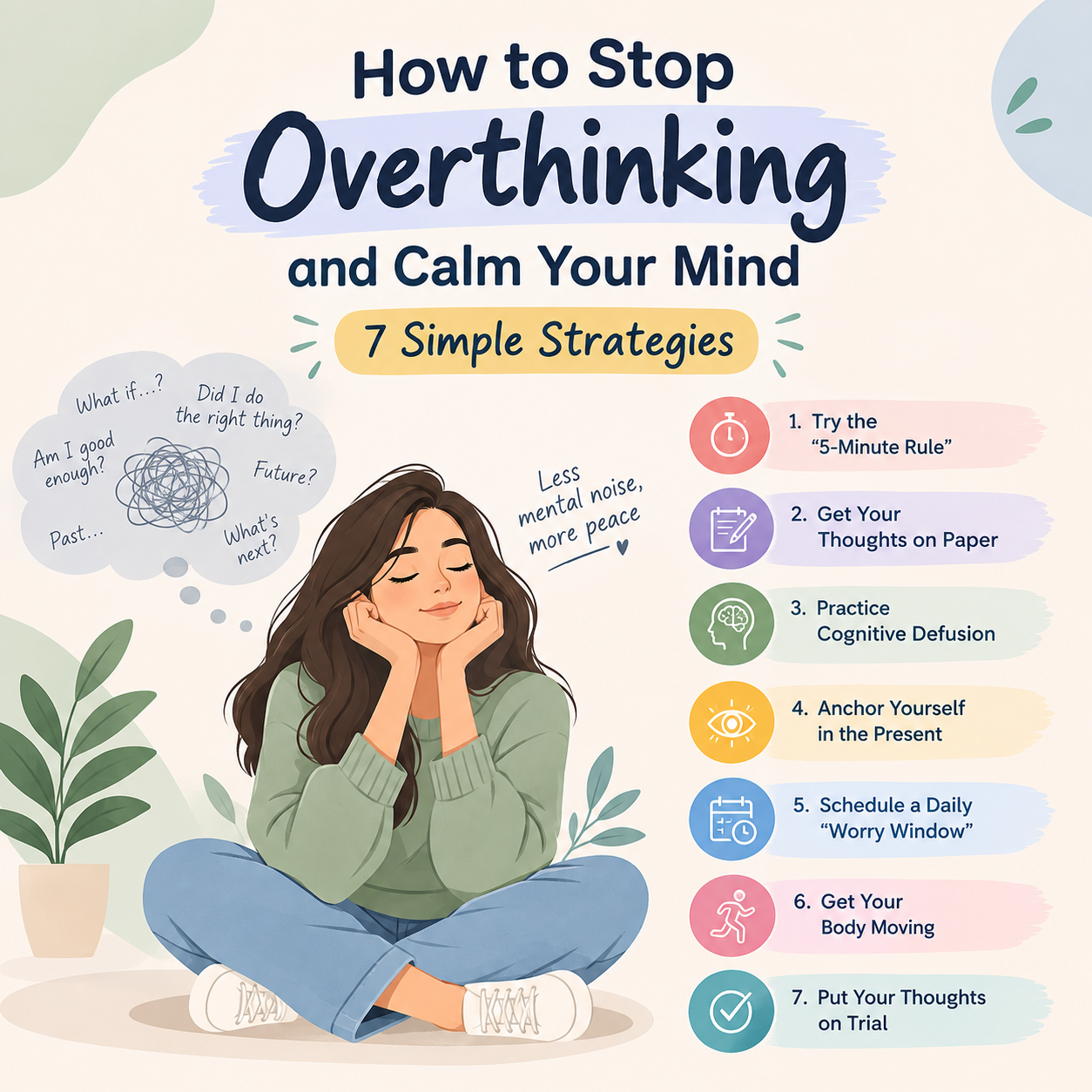
Overthinking is the habit of endlessly picking apart past situations, future decisions, or everyday problems long after it stops being useful. It’s that familiar mental loop of “what-if” scenarios that leaves you feeling stuck, drained, and constantly anxious instead of actually helping you solve anything.
Introduction
We’ve all been there staring at the ceiling at 2:00 AM, replay-playing an awkward comment from lunch, or catastrophizing over something that hasn’t even happened. In our fast-moving world, an overactive mind has become one of the biggest hurdles to everyday peace and mental clarity.
Thinking itself isn’t the villain here. We need our brains to plan, evaluate, and solve problems. The trouble starts when our thoughts turn repetitive, unproductive, and completely untethered from action. That endless loop zaps your energy, fuels your stress, and robs you of the present moment.
The silver lining? Overthinking isn’t a permanent personality trait; it’s just a habit. And like any habit, you can unlearn it. Here are seven realistic, evidence-backed strategies to help you quiet the internal noise and take back the steering wheel.
Want to understand the psychology behind overthinking, emotions, stress, and human behaviour? Explore our Complete Psychology Master Course for structured and student-friendly psychology learning.
7 Practical Ways to Quiet the Noise
1. Try the “5-Minute Rule”
How it works: Set a timer for five minutes and give yourself full permission to worry about whatever is on your mind. Don’t fight the thoughts or push them down just let them flow freely until the timer goes off.
Once the time is up, ask yourself one simple question: Is there anything I can actually do about this right now? If the answer is yes, write down one quick action step. If the answer is no, acknowledge that it’s out of your hands for now and consciously pivot your attention elsewhere.
Why it works: Trying to suppress anxious thoughts usually makes them louder. Giving yourself a dedicated moment to process your worries satisfies the urge to overthink without letting it hijack your entire day.
2. Get Your Thoughts Out on Paper
The Brain Dump: Grab a notebook and spend 10 to 15 minutes writing down every single worry, task, or chaotic thought floating around in your head. Don’t worry about neatness, grammar, or organizing your thoughts just let it all spill out.
Why it helps:
- Empties out mental clutter so your brain doesn’t have to keep “holding” it.
- Helps you spot recurring patterns in what triggers your stress.
- Puts emotional distance between you and your anxieties.
- Makes it much easier to sort real priorities from background noise.
3. Practice “Cognitive Defusion”
Separate facts from feelings: Remind yourself that a thought is just a passing electrical signal in your brain not a proven fact or a crystal ball. Thinking “I’m going to ruin this presentation” doesn’t mean you actually will; it’s just stress talking.
How to practice:
- Reframe the narrative: Shift from “I’m going to fail” to “I notice I’m having the thought that I might fail.” That tiny gap reduces the emotional sting.
- Name the pattern: Give recurring worry loops a label. Tell yourself, “Ah, there’s my catastrophizing habit again,” or “Right on cue, here comes the worst-case scenario story.”
4. Anchor Yourself in the Present
The 5-Senses Technique: When your mind starts spiraling into the future, pause and tune in to your immediate surroundings by identifying:
- 5 things you can see around you
- 4 things you can physically touch or feel
- 3 distinct sounds you can hear
- 2 scents you can smell
- 1 thing you can taste
This simple grounding exercise forces your nervous system out of a mental spiral and brings you right back into the physical present.
5. Schedule a Daily “Worry Window”
Contain your stress: Set aside 15 to 20 minutes every day preferably in the late afternoon, away from your bedtime specifically for worrying.
If an overthinking loop pops up at 10:00 AM, gently tell yourself: “Not right now. I’ll deal with this during my 4:00 PM worry window.” When your scheduled time arrives, feel free to worry all you want. Outside of that window, remind yourself that it’s off-limits. Containing stress to a specific time slot keeps it from consuming your entire day.
6. Get Your Body Moving
Break the loop physically: Overthinking feeds on physical stillness. Changing your physical state is one of the fastest ways to alter your mental state. Whether it’s a quick 10-minute walk outside, a gentle stretch, or an intense workout, moving your body breaks the mental trance.
Physical activity activates your body’s relaxation response, releases mood-boosting endorphins, and pulls your focus away from abstract thoughts and back into physical sensations.
7. Put Your Thoughts on Trial
Demand evidence: When you catch yourself catastrophizing, pause and ask yourself these realistic questions:
- What actual facts prove this worry is true?
- What evidence shows this worry might be exaggerated or false?
- If a close friend came to me with this exact fear, what advice would I give them?
- What is the absolute worst outcome, and what concrete steps would I take if it happened?
Challenging your assumptions with logic helps neutralize irrational panic and brings balance back to your thinking.
Want to learn how psychological approaches are used to understand thoughts, emotions, and behaviour? Explore our Clinical Psychology Short-Term Course for structured learning in clinical psychology concepts and practical skills.
Quick Tips for Everyday Success
- Set gentle check-ins: Place a discrete phone alarm once or twice a day with the prompt: “Where are my thoughts right now?”
- Breathe intentionally: Use the 4-7-8 method (inhale for 4 seconds, hold for 7, exhale slowly for 8) to instantly signal safety to your nervous system.
- Watch the caffeine: High intake can mimic physical panic symptoms and kick overthinking into overdrive.
- Create a quick pause button: Choose one grounding technique to use the moment you catch yourself starting to spiral.
- Be kind to yourself: Overthinking isn’t a personal failure; it’s just a deeply ingrained habit your brain formed to try to protect you.
Common Pitfalls to Avoid
- Forcing toxic positivity: Trying to slap a happy sticker on a genuine worry without addressing it rarely works.
- Beating yourself up: Getting frustrated with yourself for overthinking only adds a second layer of stress.
- Expecting overnight miracles: Unlearning mental habits takes time and consistent practice over several weeks.
- Ignoring persistent distress: If anxiety consistently interferes with your daily life, don’t hesitate to reach out to a licensed professional.
- Overthinking your overthinking: Yes, analyzing why you’re analyzing is a trap! Try to notice it and gently move on.
Overthinking vs. Productive Problem-Solving
| Aspect | Overthinking | Productive Thinking |
| Main Focus | Past mistakes & hypothetical “what-ifs” | Practical solutions & next steps |
| Timeframe | Endless, repetitive loops | Goal-driven and time-bound |
| Typical Outcome | Anxiety, fatigue, and feeling paralyzed | Mental clarity, choices, and progress |
| Action Level | Procrastination or passive rumination | Taking real, concrete action |
| Emotional State | Stuck, overwhelmed, and helpless | Calm, intentional, and grounded |
Frequently Asked Questions
- Is overthinking a formal mental health diagnosis?
No, overthinking itself isn’t a clinical diagnosis. However, chronic rumination is a key symptom of conditions like generalized anxiety disorder, OCD, or depression. If it’s significantly impacting your life, speaking with a therapist is a great next step.
- How long does it take to train your brain to stop spiraling?
Most people notice a shift within 2 to 4 weeks of consistent practice. Building new mental pathways generally takes a couple of months, so give yourself plenty of grace along the way.
- Does mindfulness or meditation actually help?
Definitely. Spending just 5 to 10 minutes a day observing your breath teaches your brain how to watch thoughts pass by without getting swept up in them.
- What’s the difference between being thorough and overthinking?
Being thorough means gathering necessary facts, making a decision, and taking action. Overthinking is reviewing the same facts repeatedly without ever making a choice or moving forward.
- Why does my brain race as soon as my head hits the pillow?
During the day, constant distractions keep your mind occupied. When everything goes quiet at night, all those unaddressed thoughts surge to the surface. Establishing an offline wind-down routine can help tremendously.
- Can being an overthinker ever be a good thing?
Attention to detail and deep reflection are great qualities. It only becomes a problem when that reflection turns into endless rumination that causes distress and blocks action. Balance is key.
- What if none of these tools seem to work for me?
Everyone’s mind operates differently. Try combining tools (like journal writing followed by a quick walk) or working alongside a cognitive-behavioral therapist (CBT) who can tailor strategies to your specific triggers.
- How can I stop overthinking major choices?
Give yourself a hard deadline, collect reasonable information, talk it through with one or two trusted people, and make the call. Remind yourself that very few decisions are completely set in stone.
Struggling with stress along with overthinking? Read How Do I Manage Stress as a Psychology Student?
Essential Takeaways
- Overthinking is a learned pattern, which means you have the power to unlearn it.
- Combining mental tools (like writing or reframing) with physical action (like movement or grounding) offers the fastest relief.
- Compassion with yourself works far better than self-criticism.
- Focus on consistency over perfection start with just one strategy today.
Final Thoughts
Overthinking is usually just your brain’s protective instinct going into overdrive, trying to predict every outcome to keep you safe. While the intention makes sense, the execution leaves you exhausted. By using these strategies giving yourself worry boundaries, writing things down, staying grounded, and challenging your fears you can disrupt those automatic loops and make space for genuine peace of mind. Pick just one tool from this guide that feels doable right now. Practice it consistently over the next couple of weeks before adding another. With time, training, and patience, you can turn down the volume on mental noise and step back into the present.