Introduction
If you’ve been searching for “psychologist without NEET,” you’re not alone. Every year, thousands of students assume psychology falls under the same medical umbrella as MBBS and requires NEET for admission. It doesn’t. At Confidante Psychology Academy, this is one of the most common misconceptions we hear from students. In this article, we’ll clear up the confusion in simple, easy to understand language with no jargon.
The confusion is understandable. NEET has become so central to India’s conversation around “serious” science careers that many students assume every health related profession runs through it. But psychology, despite dealing with the human mind and often working alongside doctors, is not classified as a medical degree in India. That single distinction changes everything about how you plan your academic path.
Do You Need NEET to Study Psychology?
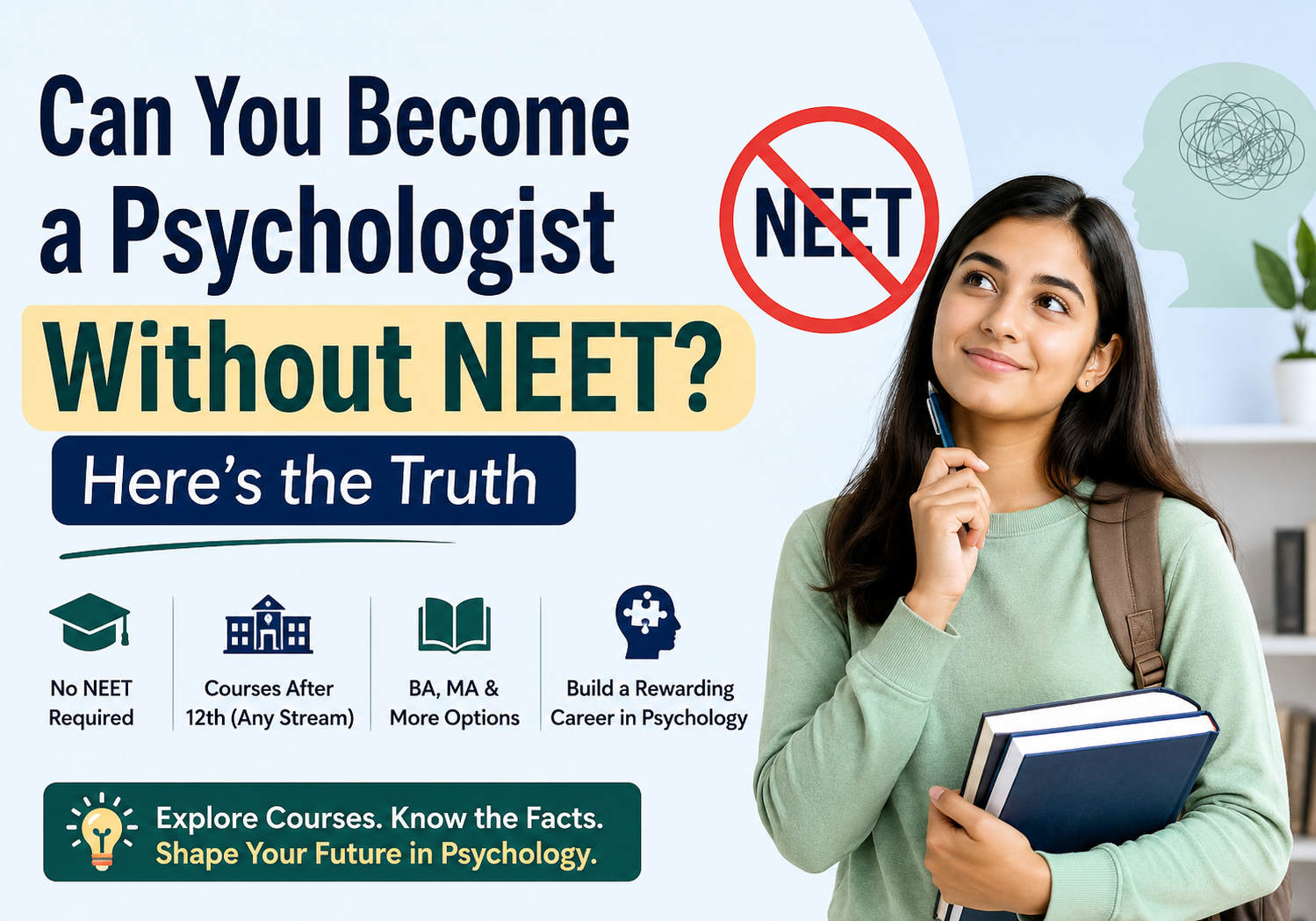
No. NEET (National Eligibility cum Entrance Test) is required only for medical and dental degree programs such as MBBS, BDS, and BAMS. Psychology is offered as a BA, BSc, or a professional postgraduate degree, none of which fall under NEET’s scope. You can enroll in a psychology program directly after completing Class 12 without appearing for NEET, regardless of whether you studied Science, Commerce, or Arts in school.
This matters because it opens the door to psychology for a much wider pool of students than most people realize, including those who never took biology, chemistry, or physics as core subjects.
Ready to start your psychology career? Explore psychology courses, internships, career guidance, and expert mentorship at Confidante Psychology Academy to find the right path for your goals.
Psychology Eligibility Criteria in India
To enroll in an undergraduate psychology program, here’s what you generally need:
- Completion of Class 12 (any stream: Science, Commerce, or Arts)
- A minimum aggregate mark as set by the specific college, typically somewhere between 45% and 60%
- English proficiency, since most courses are taught in English
- No NEET and no biology specific requirement for a general psychology degree
Because eligibility is stream agnostic, a Commerce student who has always been fascinated by human behavior, or an Arts student drawn to counselling, has exactly the same access to psychology programs as a Science student does.
Psychology Qualification Requirements in India: A Quick Table
| Degree Level | Duration | Minimum Eligibility | NEET Required? |
|---|---|---|---|
| BA/BSc Psychology | 3 years | Class 12 (any stream) | No |
| MA/MSc Psychology | 2 years | Bachelor’s in Psychology or related field | No |
| M.Phil Clinical Psychology | 2 years | Master’s + RCI entrance exam | No (RCI exam instead) |
| Ph.D. Psychology | 3 to 5 years | Master’s/M.Phil + research aptitude test | No |
Notice the pattern: at every single stage of the psychology pipeline, from your first undergraduate year all the way to a doctorate, NEET never appears. The only specialized gatekeeping exam shows up much later, and it isn’t NEET. More on that below.
Psychology Entrance Exams You Might Actually Need
Instead of NEET, some universities use their own gateways for admission:
- CUET (Common University Entrance Test), used by central universities
- IPU CET, Guru Gobind Singh Indraprastha University’s own entrance test
- Christ University Entrance Test for admission into Christ University’s psychology programs
- Direct merit based admission, where many colleges admit students purely on Class 12 marks with no separate test at all
Which route applies to you depends entirely on the specific college or university you’re targeting, so it’s worth checking each institution’s admission page rather than assuming one exam applies universally.
Bachelor’s in Psychology Without NEET
A BA or BSc in Psychology is a straightforward, three year undergraduate degree. Admission depends on your Class 12 percentage and, at some universities, a subject specific entrance test, never NEET. This is the standard route for most aspiring psychologists, and it lays the theoretical groundwork, covering areas like cognitive psychology, developmental psychology, and research methods, that everything else in the field builds on.
Master’s in Psychology Without NEET
Once you complete your bachelor’s, an MA or MSc in Psychology lets you deepen your specialization in clinical , counselling, organizational, or forensic psychology, among others. Admission is based on your undergraduate score and, sometimes, a university level entrance test. Again, NEET plays no role here. This is typically the stage where students start narrowing down the specific branch of psychology they want to build a career in.
How to Become a Psychologist Without NEET
Here’s the realistic, step by step path:
- Finish Class 12 in any stream.
- Enroll in a BA/BSc Psychology program.
- Complete a Master’s degree in your chosen specialization.
- Pursue an M.Phil in Clinical Psychology (only if you want to practice clinically) via the RCI entrance exam.
- Gain supervised practical experience.
- Register with the Rehabilitation Council of India (RCI) if you’re entering clinical practice.
Not every psychology career requires all six steps. If your goal is research, teaching, human resources, or organizational consulting, you may stop after your master’s degree. Clinical practice is the specific track that requires the additional M.Phil and RCI registration.
Can I Study Psychology Without NEET in India?
Yes, absolutely. Every recognized university in India that offers a BA, BSc, MA, or MSc in Psychology accepts students without NEET scores. This applies to both government and private institutions across the country, so location and budget, not NEET eligibility, are usually the real deciding factors for students.
Take the next step toward your psychology career download our app to access psychology courses, career resources, and learning materials anytime.
Psychology Courses Without NEET Requirement
- BA Psychology (Honours)
- BSc Applied Psychology
- MA Clinical/Counselling Psychology
- PG Diploma in Psychology
- Certificate courses in specialized areas, such as child psychology or industrial psychology
Online Psychology Degree Without NEET
Distance and online learning platforms, including UGC recognized open universities, offer psychology degrees without any entrance exam tied to NEET. This is ideal for working professionals or students in remote areas who want flexibility without compromising on a recognized credential.
Distance Learning Psychology Without NEET
Distance education boards such as IGNOU and various state open universities offer BA and MA Psychology programs. Eligibility mirrors regular colleges: no NEET, just your Class 12 or graduation certificate, making this one of the more accessible entry points into the field.
The One Exam That Actually Matters: RCI
If your goal is to practice as a clinical psychologist, you’ll eventually need to clear the RCI entrance exam for M.Phil in Clinical Psychology and register with the Rehabilitation Council of India. This is the real gatekeeping exam in this field, not NEET. It’s worth planning for early if clinical practice is your end goal, since it’s more specialized and competitive than general university admissions.
Continue Reading : Why Do We Go Blank During Exams? Psychology Explained
Quick FAQ
1. Is NEET compulsory for psychology courses?
No. NEET applies only to medical degrees like MBBS and BDS. Psychology degrees at every level, bachelor’s, master’s, and doctoral, are open without NEET.
2.What is the eligibility for BA Psychology?
A pass in Class 12 from any stream, meeting the college’s minimum percentage cutoff, usually between 45% and 60%.
3.Can science students without biology study psychology?
Yes. Since psychology isn’t a NEET linked field, students from Commerce and Arts streams are equally eligible.
4.Which exam replaces NEET for clinical psychology?
The RCI entrance exam, required only if you want to pursue an M.Phil in Clinical Psychology and practice clinically.
Final Word
Psychology is one of the most accessible degree paths in India, open to students from any academic background, with no NEET requirement at any stage. Focus your energy on choosing the right college and specialization instead of worrying about an exam that was never part of the picture.