Introduction: Why Most Psychology Candidates Fail This Balance
You’ve probably heard it: “Paper 2 is what matters most.” That’s partially true, but it’s dangerously incomplete advice. Psychology candidates who score 90+ in Paper 2 but fumble Paper 1 often miss selection cutoffs by just 5-10 marks. Here’s the reality Paper 1 has 50 questions carrying 100 marks. If you’re losing even 20 marks there, Paper 2 excellence alone won’t save you. This guide shows exactly how to split your preparation so both papers work together, not against each other.
Understanding the Paper Weightage and Scoring Dynamics
Paper 1 vs Paper 2: The Real Picture
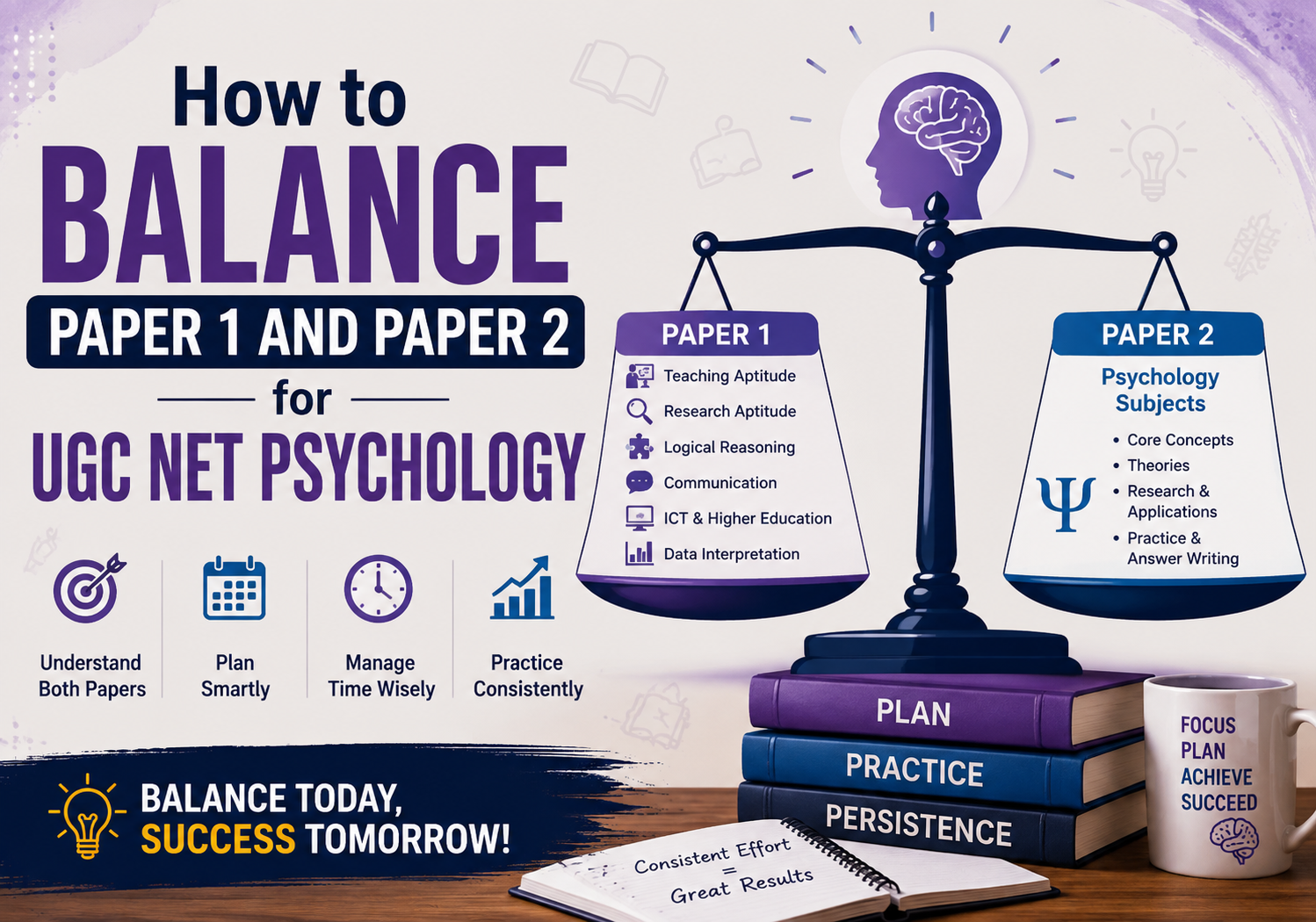
Paper 1 covers teaching aptitude, research methodology, comprehension, and logical reasoning. It seems generic, but Psychology candidates need psychology-specific teaching methods and research concepts.
Paper 2 demands deep subject knowledge across cognitive psychology, developmental psychology, abnormal psychology, social psychology, and research methods the specialized content most candidates focus on. Together, they create a 300-mark examination. Paper 2 carries roughly 67% of total marks, but Paper 1’s 100 marks can be the difference between success and heartbreak.
Preparing for UGC-NET or SET Psychology? Build a strong foundation with expert-led guidance. Explore the UGC-NET & SET Psychology Master Course – Part 1.
The Two-Phase Study Strategy for Psychology Candidates
Phase 1: Parallel Preparation (Months 1-4)
Don’t wait to finish Paper 2 before starting Paper 1. That’s the most common mistake.
Monthly allocation:
- Week 1-2: 60% Paper 2 (subject content) + 40% Paper 1 (foundational concepts)
- Week 3-4: 65% Paper 2 + 35% Paper 1
During this phase, you’re building conceptual depth in both simultaneously. While studying psychological research methods for Paper 2, you’re simultaneously learning research design for Paper 1. These overlap more than you think.
Practical approach: When studying cognitive psychology theories, dedicate 30 minutes to teaching these theories that’s Paper 1 teaching aptitude covered. When learning statistical concepts for Paper 2, spend time on research methodology questions both papers benefit.
Phase 2: Intensified Differentiation (Months 5-6)
Now allocate more aggressively:
- 75% Paper 2 (depth and completeness)
- 25% Paper 1 (refinement and speed)
Your Paper 2 foundation is solid; now polish it. For Paper 1, you’ve covered basics; now focus on weak areas and timing.
📚 Explore related article to deepen your NET preparation strategy:What Is Research Methodology? Definition, Types & Importance
Paper 1 Strategy Specifically for Psychology Candidates
What Makes Paper 1 Different for Psychology
Paper 1 feels generic because teaching aptitude and research methodology apply across disciplines. But Psychology paper examiners expect you to demonstrate teaching methods for psychological concepts, research designs used in psychology, and ethical considerations in psychological research.
Strategic approach:
Teaching Aptitude (10-12 questions)
- Learn to explain cognitive biases in classroom settings
- Understand how to teach behavioral modification concepts
- Know how psychological principles apply to educational psychology
- Don’t just memorize generic teaching tips
Research Methodology (12-15 questions)
- Master experimental designs used in psychology research
- Understand quasi-experimental approaches in clinical psychology
- Know ethical guidelines (APA standards) for psychological research
- Study mixed-method approaches common in contemporary psychology
Comprehension (10 questions)
- Practice with passages on psychological topics
- These often involve research studies, case studies, or theoretical frameworks
- Your psychology background gives you natural advantage here
Logical Reasoning (10-12 questions)
- This is the only completely universal section
- Allocate 1-2 hours weekly from month 3 onward
Paper 2 Strategy for Psychology Specialists
The Core Subjects You Can’t Skip
Psychology paper covers:
- Cognitive Psychology (15-18 questions typically)
- Developmental Psychology (10-12 questions)
- Social Psychology (10-12 questions)
- Abnormal Psychology (10-12 questions)
- Research Methods & Statistics (12-15 questions)
- Industrial-Organizational Psychology (8-10 questions)
- Other topics (History, perspectives, applied areas)
Smart allocation:
The most heavily weighted topics get 35% of your time. Cognitive and Research Methods together form nearly 30% of Paper 2. Spend proportionally more here while maintaining basic competence elsewhere.
Avoid the “Equal Study” Trap
Psychology candidates often study all topics equally. Don’t. While you need 60% understanding across all areas, you need 90%+ understanding in high-frequency topics.
Review previous 8-10 years’ papers:
- Which topics appear repeatedly? Study these like your career depends on it (it does).
- Which are rare? Learn basics only.
- Which changed recently? Give them priority because repeat questions are unlikely.
The Weekly Time Allocation Formula
Here’s what works practically:
| Time Period | Paper 1 | Paper 2 | Total |
| Months 1-3 | 6 hours/week | 18 hours/week | 24 hours |
| Months 4-5 | 5 hours/week | 20 hours/week | 25 hours |
| Month 6 | 3 hours/week | 22 hours/week | 25 hours |
| Final Revision | 2 hours/week | 23 hours/week | 25 hours |
This assumes full-time preparation. Working professionals can scale proportionally the ratio stays consistent.
Common Balancing Mistakes Psychology Candidates Make
Mistake 1: Paper 1 = Afterthought You’ll score 50-60 marks comfortably, leaving 40-50 marks on the table. Those 40 marks matter immensely.
Mistake 2: Treating Paper 1 Research Methodology Separately Paper 1 research methodology is simpler than Paper 2. You don’t need separate study materials—your Paper 2 research methods knowledge just needs contextual adjustment.
Mistake 3: Starting Paper 1 Too Late If you start Paper 1 in month 5, you rush it, retain nothing, and score poorly. Start early; study lightly.
Mistake 4: Ignoring Paper 1 Logic and Comprehension These are high-scoring sections for candidates who practice. 15 easy marks here cost many candidates their qualification.
Mistake 5: Over-studying Paper 1 You don’t need to be a teaching expert. Paper 1 has a ceiling after 65-70 marks, effort yields diminishing returns. Redirect that energy to Paper 2.
Mock Test Strategy for Balanced Preparation
How to Practice Meaningfully
Months 1-3: Separate mock tests
- Paper 1 mock: Every 2 weeks (timed)
- Paper 2 mock: Every week (topic-wise first, then full)
Months 4-5: Combined approach
- Full mock tests (both papers in sequence)
- Analyze Paper 1 weaknesses separately
- Track Paper 2 progression by topic
Month 6: Intensive combined testing
- 2-3 full mocks per week
- Review answer keys the same day
- Focus on error patterns, not just scores
Why Structured Guidance Accelerates Your Success
Confidante Psychology Academy understands that Psychology isn’t a generic subject for NET. Their Paper 1 and Paper 2 integration strategy helps candidates see the connections between subject knowledge and teaching methodology exactly what this exam demands.
Their proven approach includes:
- Customized time allocation based on your topic strengths and weaknesses
- Psychology-specific Paper 1 materials (not generic teaching resources)
- Weekly mock tests analyzing both papers simultaneously
- Error pattern tracking to prevent repeated mistakes
- Subject experts who teach both papers with integrated perspective
Ready to master both papers strategically? Explore UGC-NET & SET Psychology Master Course (Part 1 & Part 2)
Frequently Asked Questions
Q: Should I start Paper 1 and Paper 2 together?
A: Yes. Parallel preparation from month 1 is more efficient than sequential study. They share cognitive and research methodology concepts.
Q: How much time should I dedicate to Paper 1 teaching aptitude?
A: 45 minutes daily for first 3 months, then 20-30 minutes for refinement. This covers ~12-15 questions consistently.
Q: Can I score 80+ in Paper 1 as a Psychology candidate?
A: Absolutely. Most candidates settle for 60-65 because they don’t practice. Dedicated 8-week preparation gets 80+ easily.
Q: Should I memorize teaching methods or understand concepts?
A: Understand. Memorization fails in Paper 1 because questions ask application, not recall. Know teaching principles deeply.
Final Word
Paper 1 and Paper 2 aren’t separate battles they’re one unified exam. Candidates who treat them as connected systems score higher than those who don’t. Your Paper 2 knowledge becomes teaching aptitude in Paper 1. Your research methodology mastery appears in both papers. The psychology candidates getting selected aren’t necessarily the smartest in their subject. They’re the ones who prepared strategically, balanced their effort, and didn’t leave easy marks on the table.