
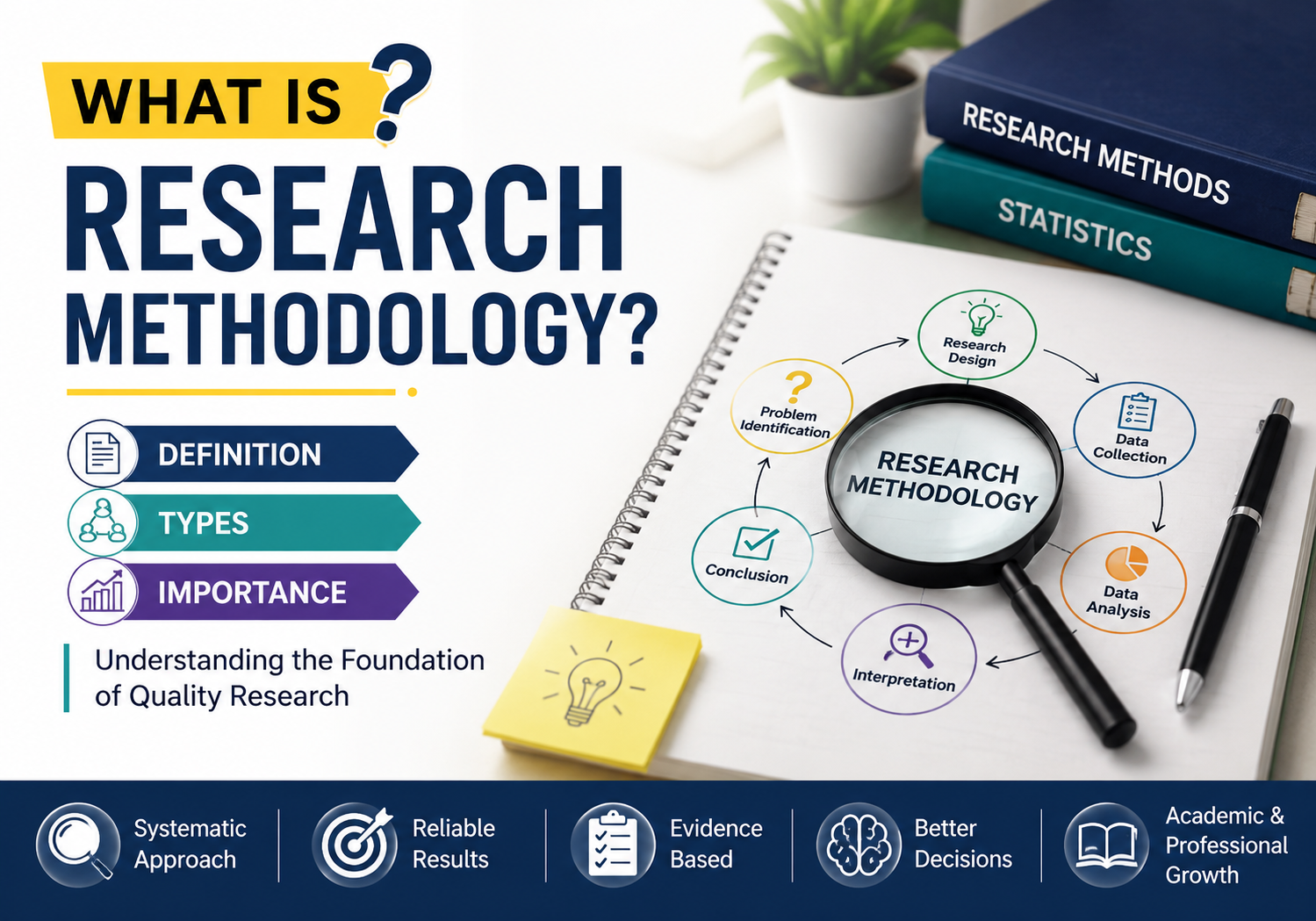
Research methodology is the systematic, theoretical framework used to collect, analyze, and interpret data within a study. It serves as the strategic blueprint that guides researchers in choosing specific methods, tools, and logical procedures to answer their core questions, ensuring their conclusions are valid, reliable, and scientifically sound.
Whether you are an undergraduate student tackling your first dissertation or an academic professional publishing an empirical paper, understanding research methodology is essential. Without a clear methodology, data collection becomes arbitrary, and findings lose their credibility.
At Confidante Psychology Academy, we emphasize to our students that mastering methodology is the single most critical step in producing rigorous, impactful research. A well-designed framework ensures that your findings withstand academic scrutiny and contribute meaningfully to your field.
What is Research Methodology? (Definition & Core Concept)
Research methodology refers to the overarching strategy and rationale behind your research process. It explains not just what data you gathered, but why you chose specific techniques to gather and evaluate it.
Research Methodology vs. Research Methods
It is common to confuse methodology with methods, but they represent two different levels of your research framework:
- Research Methodology: The broad strategy, philosophy, and systematic plan governing the study (e.g., Qualitative, Quantitative, or Mixed Methods framework).
- Research Methods: The specific tools, techniques, and procedures used to gather and analyze data (e.g., surveys, semi-structured interviews, statistical regressions).
Why is Research Methodology Important?
A structured research methodology brings clarity, structure, and validity to any investigation.
- Ensures Validity and Reliability: It verifies that your measurement tools actually measure what they claim to measure and produce consistent results.
- Prevents Researcher Bias: A predetermined plan keeps the researcher objective during data collection and analysis.
- Enables Replication and Scrutiny: It provides a clear roadmap so other academics can replicate the study to confirm its conclusions.
- Optimizes Resource Allocation: It saves time, energy, and funding by narrowing down the most efficient data collection strategies.
- Guides Data Analysis: It dictates which statistical tests or qualitative analysis models are appropriate for the collected dataset.
What are the Main Types of Research Methodology?
Choosing the right methodology depends on your research questions, objectives, and available resources.
1. Quantitative Research Methodology
Quantitative methodology focuses on collecting and analyzing numerical data. It uses structured measurements to test hypotheses, identify patterns, and establish cause-and-effect relationships.
- Common Techniques: Surveys, controlled experiments, longitudinal tracking, statistical modeling.
- Best Used For: Standardized testing, market trend analysis, scientific experiments.
2. Qualitative Research Methodology
Qualitative methodology focuses on understanding underlying concepts, human experiences, thoughts, and feelings. It relies on non-numerical data to explore complex phenomena in-depth.
- Common Techniques: Open-ended interviews, focus groups, observational field studies, thematic analysis.
- Best Used For: Psychological evaluations, exploratory social studies, user experience research.
3. Mixed Methods Research Methodology
Mixed methods combine qualitative and quantitative approaches within a single study. This provides a complete picture by combining numerical trends with human context.
- Common Techniques: Conducting closed-ended surveys followed by detailed follow-up interviews.
- Best Used For: Complex social science investigations, medical case studies.
Qualitative vs. Quantitative vs. Mixed Methods
| Feature | Quantitative | Qualitative | Mixed Methods |
| Data Type | Numerical, statistical | Descriptive words, images | Numbers and descriptive context |
| Logic | Deductive (tests theory) | Inductive (builds theory) | Combined (tests and expands theory) |
| Sample Size | Large, representative | Small, purposive | Varies by design stage |
| Primary Goal | Measure, quantify, generalise | Explore, understand, describe | Validate, corroborate, deepen context |
| Analysis | Statistical software (SPSS, R) | Thematic coding (NVivo, Atlas.ti) | Joint matrix analysis |
How to Choose the Right Research Methodology: A Step-by-Step Process
- Define Your Research Objectives: Identify whether your goal is to test an existing theory (quantitative) or explore a new concept (qualitative).
- Determine Your Data Requirements: Decide whether you need numerical datasets or descriptive responses.
- Select Collection Tools: Match your questions with appropriate data collection methods like surveys, interviews, or archival review.
- Establish an Analysis Plan: Plan your analytical framework such as regression analysis or thematic analysis before gathering data.
- Address Ethical Standards and Constraints: Factor in ethical approvals, sample accessibility, timeline, and budgetary limits.
💡 Ready to Apply Research Methods in Real Counseling Settings?
Theory is only half the battle. Bridge the gap between research methodology and real-world therapy through our Online Counselling Psychology short – term Course.
Common Mistakes to Avoid in Research Methodology
- Confusing Methods with Methodology: Explaining tools without justifying why they were chosen.
- Ignoring Sample Limitations: Failing to address sample bias or small sample sizes.
- Mismatched Objectives and Design: Selecting a quantitative design for an exploratory topic that requires qualitative depth.
- Lacking Ethical Clarity: Omitting details about informed consent, data security, or institutional approval.
- Omit Reproducibility Details: Leaving out specific steps makes it difficult for other researchers to replicate the study.
Frequently Asked Questions
Why is research methodology important in a thesis?
A research methodology provides clear proof that your academic study is grounded in valid scientific principles. It allows evaluation committees and peer reviewers to assess the reliability of your data and determine if your conclusions are legitimate.
How do I choose the right research methodology for my paper?
Start with your research question. If your question asks “how many” or “what is the effect of,” choose a quantitative methodology. If your question asks “how” or “why people feel a certain way,” choose a qualitative methodology.
What are common mistakes in writing a research methodology section?
Common mistakes include listing tools without explaining why you chose them, ignoring sample limitations, using inconsistent data gathering procedures, and failing to document ethical considerations.
What is the difference between primary and secondary methodology?
Primary methodology involves collecting fresh, original data directly from sources using surveys, experiments, or interviews. Secondary methodology focuses on analyzing pre-existing datasets, historical records, or published literature.