
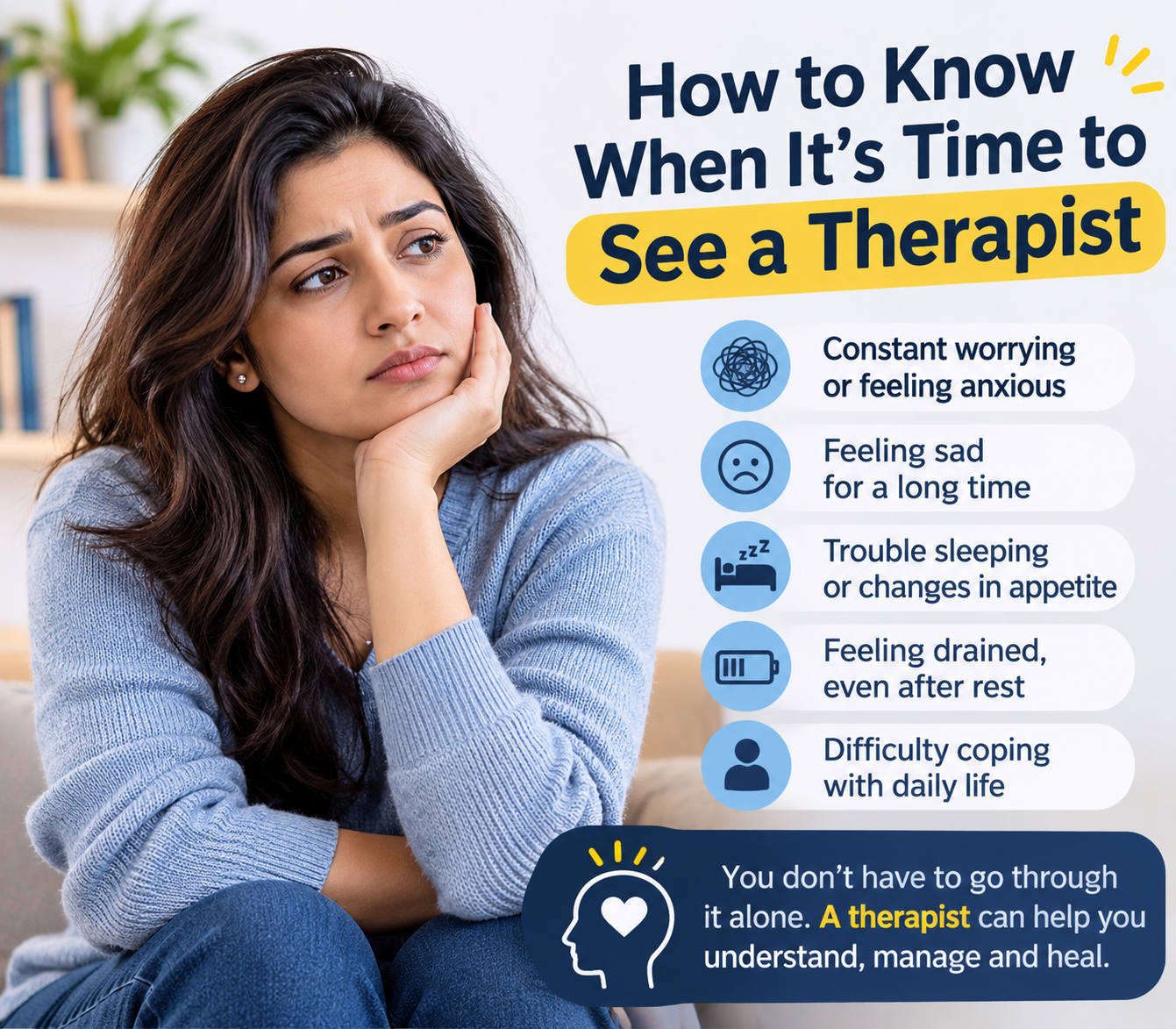
If you are experiencing mental and/or emotional difficulties which are persisting for more than a few weeks, affecting work/study and/or your sleep and/or relationships and you find them difficult to manage, then therapy may be suitable. There does not necessarily have to be a crisis and/or diagnosis. Even if your normal coping strategies are no longer effective then it is still valid to seek help.
People commonly delay accessing help. They convince themselves that they are merely stressed and that somebody else’s situation is worse. Often they also believe that they should be able to cope. However, in reality, therapy is not a last resort. It is a place where you can develop skills. Generally speaking the sooner you seek therapy the easier it is. Below are indicators to help you recognise when therapy may be appropriate and to distinguish between normal stress and more serious issues. I then describe how to begin therapy.
What Does a Therapist Do?
Therapists are professionals trained to work with people’s mental health. They can be psychologists, counselling psychologists and/or clinical psychologists. Common therapeutic techniques used are cognitive behavioural therapy (CBT), rational emotive behaviour therapy (REBT) and person-centred therapy.
10 Indicators That You May Benefit from Therapy
Emotional
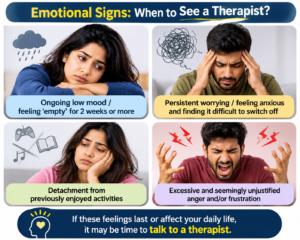
- Ongoing low mood/feeling ‘empty’ for 2 weeks or more
- Persistent worrying/feeling anxious and finding it difficult to switch off
- Detachment from previously enjoyed activities
- Excessive and seemingly unjustified anger and/or frustration
Physical and Behavioural
- Sleep disturbance (for example, insomnia or oversleeping)
- Altered eating and/or energy levels with no physical reason
- Reduced social interaction (with both friends and family) and/or non-engagement with regular activities
- Unhealthy ways of managing your emotions (for example, drinking too much alcohol, compulsive online activity and/or working too hard)
Functional
- Impaired work and/or study performance
- Continually experiencing similar relationship issues
Looking for Professional Guidance or Psychology Training?
Explore Confidante Psychology Academy for psychology learning opportunities, psychological assessment, and professional guidance.
Visit our website or contact us to know more about our services and courses
How Can I Tell If I Am Stressed or Facing More Serious Issues?
Whilst stress is often associated with a particular reason, it normally improves when that issue is resolved. Mental health issues, however, are often long lasting and tend to affect various aspects of someone’s life. They are often also felt to be beyond a person’s control. Refer to the table below for a general indication.
| Factor | Normal stress | Therapy |
| Length of time | Days (and then stabilises) | 2 weeks or more |
| Cause | Identifiable (for example, examination or deadline) | Not identifiable and/or persists beyond the initial reason |
| Impact on daily life | Minimal | There is obvious negative impact on work, sleep and/or relationships |
| Coping | Relaxation and discussion are effective | Standard coping strategies are ineffective |
| Physical | Minor fatigue | Persistent issues such as headaches and/or ongoing fatigue, together with altered sleep and/or eating habits |
| Perspective | “I’ll soon recover.” | “There won’t be any change.” |
Note: This is just general information. Only a professional can analyse your situation.
Common Reasons for Delaying Help
- “I’m not that bad.” Whilst you don’t need to be in extreme distress, it is preferable to seek therapy prior to reaching this stage.
- “Doing so shows I am weak.” In fact, accessing therapy requires even greater bravery than keeping quiet. It is more akin to attending the gym, and is in no way comparable to visiting A&E.
- “I can’t afford it.” Numerous therapists provide cost-effective, online and/or brief therapy. Enquire about these options.
- “What will people think?” Therapy is confidential. Furthermore, in contrast to popular belief, an increasing number of people are accessing therapy.
Example
Following postgraduate study, a 24-year-old woman has been having poor sleep and has under-performed in classes. She has also become easily angered and has argued with her family. She attributes this to examination related stress. Unfortunately, even post-exams she continues to feel weighed down. Crucially, although the original problem has been resolved, her symptoms remain. Through a small number of therapy sessions she analyses her anxiety and develops new skills to better manage it. Within a few weeks she begins to feel much better.
Want to Develop Your Counselling Psychology Skills?
Explore our Short-Term Counselling Psychology Course and learn more about counselling concepts and practical applications.
How to Begin Therapy
- List your observations – including your symptoms together with how long they have been present and which areas of your life they are impacting.
- Establish what you want from therapy – for example, emotional support, career direction, stress management or something else.
- Identify a suitable professional and confirm their credentials and specialism.
- Hold an introductory appointment. View this as an exploratory meeting.
- Allow sufficient time. Typically, people require a number of meetings in order to both relax and see benefits.
Therapist, Counsellor or Psychiatrist – Which Should I Consult?
- Counsellor or counselling psychologist – for managing normal stresses, and for relationship, career and/or academic related issues
- Clinical psychologist – for dealing with anxiety, depression and trauma together with conducting diagnosis
- Psychiatrist – a medical doctor who can also prescribe drugs
Initially consult a psychologist. They can then, if necessary, make referrals.
What Occurs During My Initial Therapy Appointment?
Generally there is a friendly atmosphere. The therapist will wish to understand why you are seeking help together with some background information and details of your aims. As with most situations you can divulge as much or as little information as you wish. All discussions are confidential except in very limited circumstances, which your therapist will clarify.
About Confidante Psychology Academy
Established in Pune, Confidante Psychology Academy was created by Dr Arti Kandolkar. She has a PhD in Clinical Psychology and is SET qualified. With 18+ years’ experience in teaching, mentoring and clinical practice, Dr Kandolkar is particularly recognised for delivering psychology related training (such as UGC-NET and SET).
In addition, she provides a supplementary online professional counselling service. This is available to students and parents and is aimed at assisting individuals to obtain greater understanding regarding career direction, academic stress and/or emotional wellbeing. Further details can be found on our About page.
Common Errors to Avoid
- Delaying help until a crisis arises
- Discontinuing therapy following an unsuccessful first meeting
- Anticipating immediate improvement
- Not confirming a therapist’s credentials
- Self-diagnosing using internet sources rather than consulting a professional
Fast Self-Assessment
- Have my emotions been present for 2 weeks or more?
- Have my sleep, eating and/or energy levels changed?
- Has my work, study and/or relationship life been negatively impacted?
- Are my usual coping strategies ineffective?
- Do I feel stuck, despondent and/or continually on edge?
If you have selected two or more of the above points then it may be appropriate to consult a professional.
FAQs
1. When Do I Need Therapy?
You may require therapy if you are experiencing prolonged emotional difficulty, and if this is impacting on your life. Typical indications are issues relating to sleep, mood, relationships and concentration. Again, there is no requirement for a diagnosis in order to begin therapy.
2. Is It Okay to Access Therapy Even If I Am Not in Crisis?
Yes. Indeed, many people access therapy for non-crisis related reasons. These include managing stress; adapting to life changes; and exploring relationship and/or self-development issues. Usually, early intervention avoids issues escalating.
3. How Long Can I Be Sad Before I Should Seek Help?
If you have been feeling low, apathetic and/or hopeless for 2 weeks or more then it is advisable to consult a professional. Furthermore, if you are experiencing self-harming ideas you should seek help without delay.
4. Can Therapy Assist with Anxiety and Stress?
Yes. For instance, cognitive behavioural therapy enables you to recognise and then modify unhelpful thinking. Most people begin to see benefits after a number of therapy sessions. Again, this can differ from person to person.
5. How Do I Locate an Appropriate Therapist?
Analyse a therapist’s credentials, specialism and style. Hold an introductory appointment and assess whether you feel understood and at ease. The most important aspect is ensuring a good match.
6. Is Online Therapy as Efficient as Face-to-Face Therapy?
For numerous issues, such as stress, anxiety and (moderate) depression, research suggests that online therapy can be highly effective. Nevertheless, more intense conditions may require in-person therapy.
Summary
- Therapy is not exclusively for crisis situations
- Prolonged emotional issues are a key indicator
- Monitor your sleep, mood, energy and relationships
- Urgently access support if you are experiencing self-harming ideas
- An introductory meeting simply involves discussion