
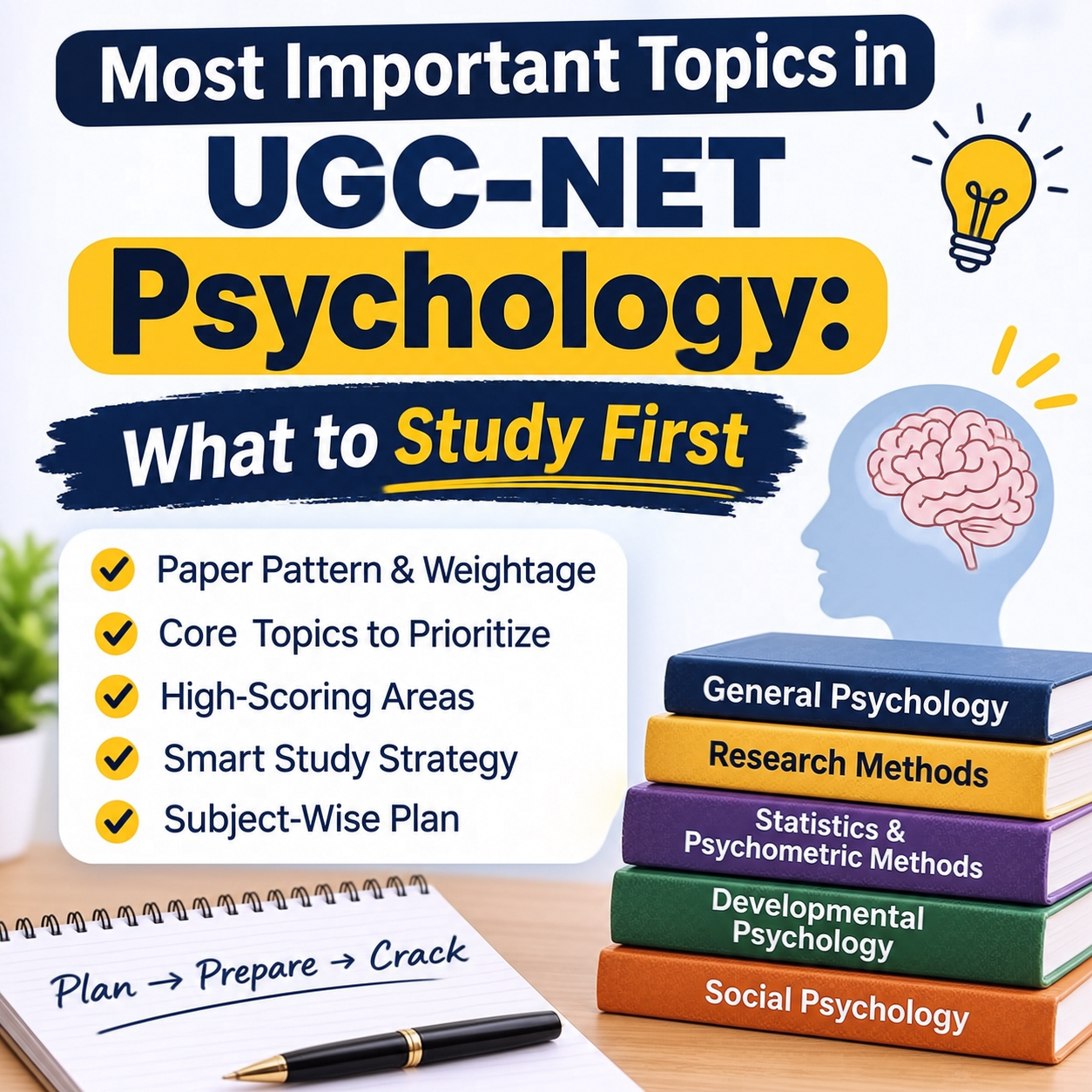
The most important topics in UGC-NET Psychology include research methods and statistics, psychological testing, cognitive processes, personality and intelligence, developmental and social psychology, and clinical psychology. These areas feature in almost every Paper 2 exam and often include predictable, concept-based questions, so give them the largest share of your study time.
The UGC-NET Psychology syllabus is vast, and trying to give every unit equal attention can quickly lead to burnout. Successful aspirants prioritise. This guide explains which units are worth focusing on, how to prepare for them, and which common mistakes can cost you marks.
UGC-NET Psychology Exam Pattern
The NTA conducts the exam in two papers. Paper 1 covers teaching and research aptitude, while Paper 2 focuses on psychology (subject code 29) across 10 units. Before planning your schedule, check the latest NTA notification for the marks and duration.
Which Topics Are Most Important in UGC-NET Psychology?
1. Research Methods and Statistics
This is one of the most dependable units for scoring well. Questions are often direct, and many of the same concepts come up year after year.
Focus on:
-
- Experimental, quasi-experimental, and correlational designs
- Sampling techniques and types of variables
- Parametric and non-parametric tests
- t-test, ANOVA, chi-square, and correlation
- Reliability and validity
Example: If a question asks which test is used to compare the means of three groups, the answer is ANOVA. Rather than memorising formulas, focus on understanding which test to use and when.
2. Psychological Testing and Assessment
Cover test construction, item analysis, norms, and different types of reliability. Familiarise yourself with major tools, including the Wechsler scales, MMPI, TAT, Rorschach, and 16PF.
3. Cognitive Psychology
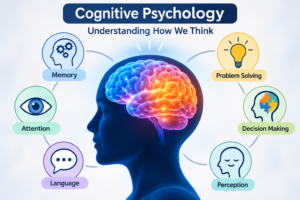
This unit covers attention, perception, memory, thinking, and language. Important models include Broadbent’s filter model, the Atkinson-Shiffrin memory model, and Baddeley’s working memory.
4. Personality and Intelligence
Expect questions on Freud, Jung, Adler, Rogers, Eysenck, Cattell, and the Big Five. For intelligence, make sure you know the theories of Spearman, Thurstone, Guilford, Gardner, and Sternberg.
5. Developmental and Social Psychology
Piaget, Vygotsky, Kohlberg, Erikson, and Bowlby come up time and again. In social psychology, focus on attribution, cognitive dissonance, conformity, and prejudice, as well as the studies by Asch, Milgram, and Zimbardo.
6. Clinical and Counselling Psychology
Review the DSM-5 categories, the basics of psychopathology, and therapies such as CBT, REBT, psychoanalysis, and person-centred therapy.
7. Learning, Motivation, and Emotion
Know the difference between classical and operant conditioning, and review Bandura’s social learning theory, Maslow, McClelland, and the James-Lange, Cannon-Bard, and Schachter-Singer theories.
8. Biological Bases and Applied Areas
Keep revising neurons, neurotransmitters, the brain’s lobes, and the endocrine system. Industrial-organisational, health, and educational psychology may appear less often, but they’re relatively easy marks.
Topic Priority Table
| Topic | Difficulty | Scoring Potential | Priority |
| Research methods and statistics | Medium | High | Very high |
| Psychological testing | Medium | High | High |
| Cognitive psychology | Medium | Medium-High | High |
| Personality and intelligence | Easy-Medium | High | High |
| Clinical and counselling | Medium | High | High |
| Social psychology | Easy | Medium-High | Medium-High |
| Biological bases | Hard | Medium | Medium |
| Applied areas | Easy | Medium | Medium |
This reflects commonly observed patterns, not official weightage. Cross-check with previous years’ papers.
About Confidante Psychology Academy
Confidante Psychology Academy is an online learning platform based in Pune that makes psychology easier to understand and easier to master. It was founded by Dr. Arti Kandolkar, a professor with a PhD in Clinical Psychology, a SET qualification, and more than 18 years of experience in teaching, mentoring, and clinical practice.
The academy aims to make psychology education accessible, supportive, and meaningful for every learner. Its courses cover UGC-NET and SET Psychology, Psychology as an optional subject for UPSC, MPSC, and State PSC exams, and Master’s-level syllabus topics. Students can learn through recorded lectures taught by Dr. Kandolkar, along with PDF notes.
How Do You Prepare for UGC-NET Psychology? (5 Steps)
-
- Download the latest syllabus and mark each unit as strong, average, or weak.
- Begin with research methods and statistics to build confidence early.
- Focus on one unit at a time, making short notes that connect each theorist with their theory.
- Solve at least five years’ worth of past papers and keep track of frequently tested topics.
- Revise every week, then take timed mock tests during the final two months.
Real-world scenario: One candidate spent six months studying every unit equally but still struggled with testing and statistics. After shifting to a priority-based plan and working through past papers, they saw clear improvement within eight weeks. Focus matters more than volume.
Common Mistakes to Avoid
-
- Skipping statistics because it feels too much like maths
- Memorising names without understanding the ideas behind them
- Ignoring Paper 1, even though it can affect your cutoff
- Reading five books instead of revising one or two thoroughly
- Leaving out previous-year questions
Quick Revision Checklist
-
- Research designs and statistical tests
- Key psychological tests and their authors
- Models of memory and attention
- Theories of personality and intelligence
- Developmental stages and their theorists
- DSM-5 disorders and therapies
- Classic social psychology experiments
Frequently Asked Questions
1. Which unit is most important in UGC-NET Psychology?
Research methods and statistics, followed by psychological testing. Their questions are direct, concept-based, and consistent across attempts, which makes them the safest place to invest early study hours.
2. How many units are there in UGC-NET Psychology?
Paper 2 has 10 units, from research methodology to applied psychology. Check the official NTA syllabus for the latest version before you begin.
3. How to prepare for UGC-NET Psychology in 6 months?
Divide the syllabus by priority, finish high-scoring units first, solve previous year papers monthly, and spend the last two months on mock tests and revision.
4. What are the best books for UGC-NET Psychology?
Commonly recommended titles include Ciccarelli’s Psychology, Morgan and King’s Introduction to Psychology, Baron’s Social Psychology, and Anastasi’s Psychological Testing.
5. Are previous year papers enough?
They are essential but not enough alone. Use them to spot patterns, then fill gaps from standard textbooks.
6. How long does UGC-NET Psychology preparation take?
With a psychology background, 5 to 6 months of steady study usually works. Beginners may need 8 to 10 months.
Summary Box
-
- Start with research methods, statistics, and testing
- Pair every theorist with their theory
- Solve previous year papers early
- Revise weekly, test monthly
- Don’t ignore Paper 1