Definition
A short-term clinical psychology course in India is a certificate or diploma program (typically 6–24 months) that equips professionals with foundational clinical psychology skills, assessment techniques, and counseling competencies. These programs prepare graduates for roles in mental health centers, hospitals, NGOs, or independent practice without requiring a full postgraduate degree.
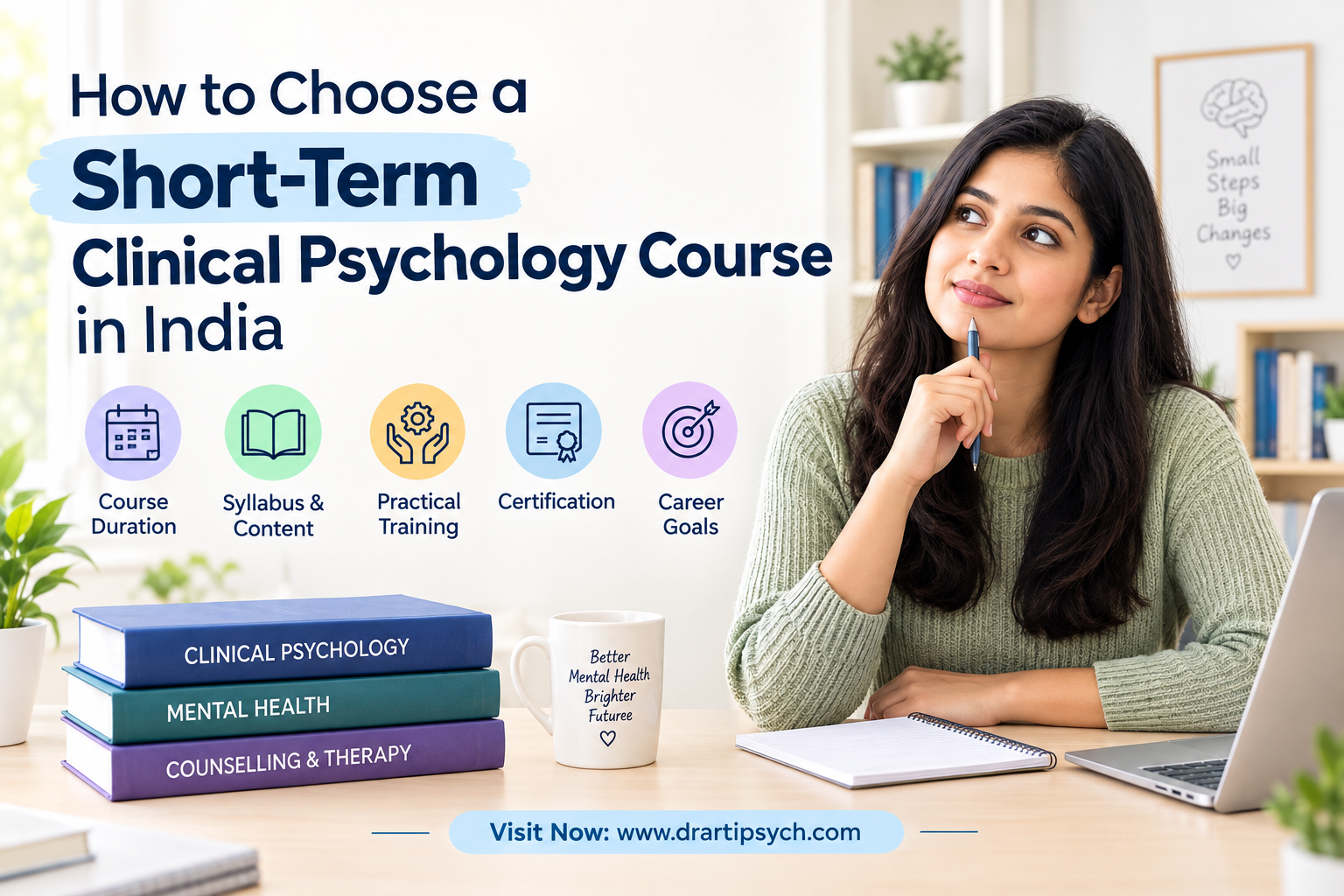
Selecting the right short-term clinical psychology course is a critical decision that impacts your career trajectory, professional credibility, and earning potential. India offers numerous programs, ranging from online certificates to intensive diplomas, making it essential to evaluate curriculum quality, accreditation, faculty expertise, and practical training opportunities.
This guide walks you through evidence-based criteria to identify courses that match your career goals, financial capacity, and learning preferences.
Understanding Short-Term Clinical Psychology Courses in India
What Are Short-Term Clinical Psychology Courses?
Short-term programs provide focused training in clinical assessment, psychotherapy, and counseling without requiring a full Master’s degree. They range from:
| Program Type | Duration | Credential | Typical Cost |
| Online Certificate | 3–6 months | Certificate | ₹15,000–₹50,000 |
| Diploma | 12–18 months | Diploma | ₹50,000–₹2,00,000 |
| Advanced Certificate | 6–12 months | Certificate/Diploma | ₹30,000–₹1,00,000 |
| Specialized Certificate | 3–9 months | Certificate | ₹20,000–₹80,000 |
Types of Short-Term Courses Available
Clinical Assessment & Psychodiagnostics
- Psychological testing and interpretation
- Duration: 6–12 months
- Best for: Aspiring assessment specialists
- Theoretical foundations and practical skills
- Duration: 12–18 months
- Best for: Counselors and therapists
Child & Adolescent Psychology
- Specialized training for younger populations
- Duration: 9–15 months
- Best for: School and developmental psychology focus
Trauma & Crisis Counseling
- Evidence-based trauma treatment
- Duration: 6–12 months
- Best for: Disaster management and crisis intervention
Online & Hybrid Programs
- Flexible, technology-enabled learning
- Duration: Varies (3–24 months)
- Best for: Working professionals
Key Criteria for Choosing the Right Course
Accreditation & Recognition
This is non-negotiable. Verify:
✓ RCI Registration – Rehabilitation Council of India accreditation ensures quality standards
✓ IPA Affiliation – Indian Psychological Association membership adds credibility
✓ University Recognition – Courses under IGNOU, universities offer transferable credentials
✓ ISO Certification – Some institutes have ISO 9001 or similar standards
✓ Ministry of Education Approval – Confirms regulatory compliance
Red Flag: Unaccredited courses may not be recognized by employers or regulatory bodies.
Unaccredited programs offer no professional standing in India’s regulated mental health landscape. Always request accreditation documentation before enrollment.
Faculty Qualifications & Expertise
Evaluate instructor credentials:
- Minimum qualification: M.Phil or Ph.D. in Clinical Psychology
- Experience: Minimum 5+ years in clinical practice
- Published research: Articles in peer-reviewed journals
- Specializations: Faculty should have diverse expertise (therapy, assessment, child psychology, etc.)
- Industry connections: Faculty with hospital/clinic affiliations provide networking opportunities
Strong faculty directly correlates with course quality and hands-on learning value.
Curriculum & Course Content
Essential components:
- Psychopathology and diagnosis (DSM-5/ICD-11)
- Psychological assessment and testing
- Psychotherapy theories and techniques
- Counseling skills and communication
- Ethics and professional conduct
- Cultural sensitivity and diversity
- Case management and documentation
- Practical supervision and internship
Ideal curriculum includes:
- Minimum 40% practical/hands-on training
- Real-world case studies
- Skill-based workshops
- Supervised clinical experience
Compare syllabi across institutions to identify which best aligns with your career goals.
Practical Training & Internship Opportunities
Short-term courses should provide supervised clinical experience:
Quality indicators:
✓ Affiliated hospitals or mental health centers
✓ Minimum 200–500 supervised practice hours
✓ One-on-one supervision with experienced clinicians
✓ Diverse client populations (anxiety, depression, trauma, psychosis, etc.)
✓ Formal internship evaluation and feedback
Questions to ask:
- Where will I complete my internship?
- What is the supervisor-to-trainee ratio?
- How many hours of supervised practice are included?
- Can I choose my placement location?
Internship quality determines skill development and job readiness.
Looking for a Practical Clinical Psychology Short-Term Course?
If you are looking for structured learning with practical exposure, explore the Clinical Psychology Short-Term Course by Confidante Psychology Academy. The course is designed for learners who want to build foundational knowledge of clinical psychology, understand psychological assessment, develop clinical skills, and gain practical learning experience.
Cost & Affordability
The cost of psychology courses can vary depending on the institute, course duration, curriculum, faculty expertise, certification, and whether the program is conducted online or in person. When choosing a course, it is important to consider more than just the course fee. Look at the quality of training, practical exposure, learning resources, certification, faculty experience, and overall career relevance.
An affordable course can be valuable when it provides structured learning and practical skills that match your educational or career goals. Comparing these factors can help you choose a psychology course that offers meaningful learning and long-term value.
Learning Mode & Flexibility
Choose based on your situation:
Full-Time In-Person:
- Pros: Intensive training, networking, direct supervision
- Cons: Time commitment, location-dependent
- Best for: Full-time students or those relocating
Part-Time/Weekend:
- Pros: Work while studying, flexible schedule
- Cons: Longer duration, divided focus
- Best for: Working professionals
Online & Hybrid:
- Pros: Geographic flexibility, self-paced options
- Cons: Limited hands-on supervision, potential isolation
- Best for: Remote areas, working individuals
Blended (Online theory + In-person practicum):
- Pros: Flexibility + practical experience
- Cons: Travel to practicum sites required
- Best for: Best of both worlds
Placement & Career Support
Evaluate job support:
✓ Placement assistance and job board access
✓ Alumni network and mentorship
✓ Career counseling and skill development
✓ Employer partnerships and tie-ups
✓ Resume building and interview preparation
✓ Internship-to-job conversion rates
FAQ Section
Q1: Is an online short-term course recognized in India?
Online courses from accredited institutions (IGNOU, recognized universities) are fully recognized. However, verify RCI or institutional accreditation before enrollment. Some employers prefer in-person training for hands-on skills.
Q2: How long does it take to secure a job after completing the course?
Graduates from well-placed programs typically secure jobs within 3–6 months. Strong candidates with internship experience often receive offers before graduation. Job market varies by location and specialization.
Q3: Do I need a psychology bachelor’s degree to enroll?
Most short-term courses accept candidates from any background, though psychology or related fields are preferred. Some programs require minimum 12th education; others prefer graduates. Check specific prerequisites.
Q4: Which is better: online or in-person training?
In-person offers superior practical training and mentorship. Online offers flexibility. Hybrid programs combine both advantages. Choose based on your learning style and life circumstances. In-person is generally preferred for clinical psychology due to hands-on skill development.
Q5: Are short-term courses equivalent to a Master’s degree?
No. Short-term courses (12–18 months) are diplomas/certificates. Master’s degrees (2 years) are more comprehensive. Short-term programs prepare you for entry-level roles; Master’s opens advanced positions and research opportunities.
Q6: What’s the difference between a certificate and a diploma?
Certificates are shorter (3–6 months), less rigorous, and often focused on specific skills. Diplomas are longer (12–24 months), comprehensive, and carry more professional weight. For career advancement, diplomas are preferable.
External References
- Rehabilitation Council of India (RCI). (2023). Accreditation Guidelines for Clinical Psychology Programs. Retrieved from www.rciindia.org
- Indian Psychological Association (IPA). Professional standards and ethical guidelines. Retrieved from www.indianpsychology.org
- Indira Gandhi National Open University (IGNOU). Diploma in Counselling Psychology. Retrieved from www.ignou.ac.in
- NIMHANS, Bangalore. Diploma in Clinical Psychology. Retrieved from www.nimhans.ac.in
- Ministry of Education, India. Recognition of institutions offering psychology programs.