Introduction
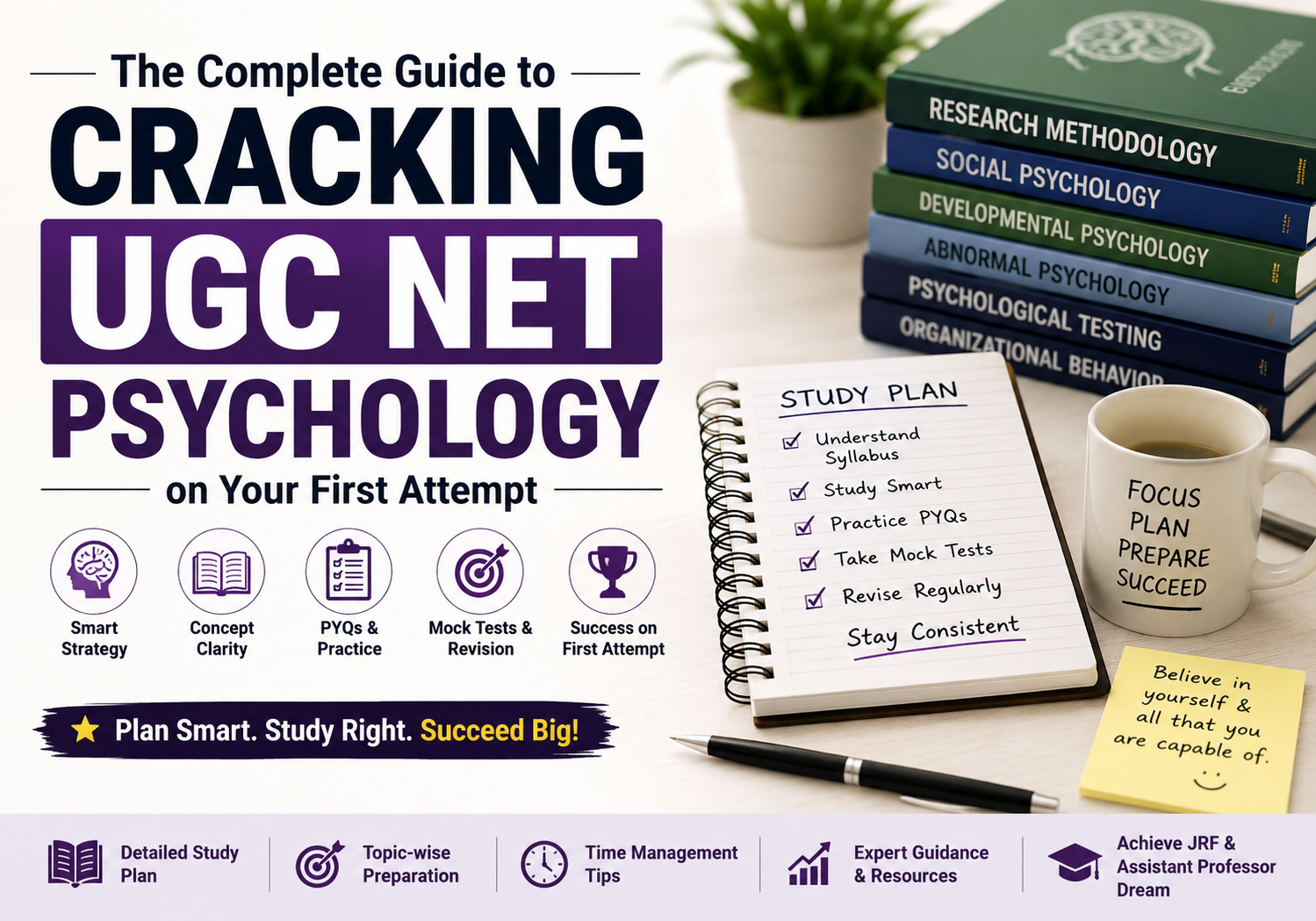
While thousands of aspirants attempt the UGC NET Psychology exam annually, many underestimate its complexity before they begin. However, the reality is refreshing: with the right strategy, it’s entirely achievable. Though only 25-30% of candidates succeed on their first attempt, this statistic doesn’t apply to those who approach preparation methodically. Success requires a well-structured plan, consistent effort, and psychological resilience.
What Makes UGC NET Psychology Distinct?
Unlike standard competitive examinations that reward memorization, this test evaluates three essential dimensions:
- Conceptual Understanding – Comprehensive knowledge of psychological theories, research, and their applications beyond surface-level definitions
- Research Competency – The ability to interpret research methodology, understand statistical concepts, and critically analyze findings
- Practical Application – Real-world problem-solving skills using psychological principles and frameworks
This emphasis on depth over breadth distinguishes UGC NET Psychology from conventional exams. Memorization alone won’t suffice; you need genuine conceptual clarity.
Ready to crack UGC NET Psychology on your first attempt? Explore our comprehensive UGC NET Psychology Master Course
Understanding the Exam Structure
Here’s what you need to know about the examination format:
- 120 questions total (all multiple choice)
- 2.5 hours to finish
- 240 marks possible
- You need 96 marks (40%) to pass
- +2 for right, -0.83 for wrong (yeah, that negative marking stings)
- Paper 1: 30 questions on teaching and research aptitude
- Paper 2: 90 questions on actual psychology stuff
That negative marking is real. So don’t be guessing randomly it’ll kill your score.
12-Month Preparation Plan
Months 1-3: Foundation Building
Month 1: Establish Your Knowledge Base
Begin by revisiting Class 11-12 NCERT psychology texts, which provide an excellent conceptual foundation. Create comprehensive mind maps for each psychology domain to visualize interconnections. Consider enrolling in a coaching program or structured online course to establish a systematic framework while self-study is viable, guided structure accelerates progress. Identify your weaker areas early to allocate additional preparation time appropriately.
Months 2-3: Core Concept Development
Systematically study each psychology domain: General Psychology, Developmental, Social, Cognitive, Abnormal, Educational, and Industrial-Organizational Psychology. The critical distinction here is understanding the “why” behind concepts rather than memorizing isolated definitions.
When studying, ask yourself: What problem was this theory addressing? What did the researcher discover, and why does it matter? This deeper engagement with material builds the conceptual foundation necessary for success.
Essential Strategy: Dedicate 2-3 hours daily during this phase. Employ the Feynman Technique by explaining concepts in simple language to test your understanding. If you struggle to articulate an idea simply, it signals a gap in comprehension that requires revisitation.
Months 4-6: Advanced Mastery of High-Impact Domains
This phase focuses on the subjects carrying the highest exam weightage:
- Research Methodology – Critical for both papers and provides competitive advantage
- Statistics & Data Interpretation – Essential for understanding research outcomes
- Developmental Psychology – Comprises 15-20% of examination questions
- Social Psychology – Accounts for 12-15% of the syllabus
- Cognitive Psychology – Represents 10-12% of test content
- Abnormal Psychology – Covers 8-10% of questions
Recommended Approach:
Select authoritative textbooks that prioritize explanation over mere definition. Supplement academic reading with published psychology research papers reading even 2-3 papers monthly familiarizes you with research design, statistical interpretation, and scholarly discourse. Incorporate video lectures for particularly complex topics. Develop comprehensive comparison charts mapping different theories, their key researchers, and practical applications.
Reading peer-reviewed research papers may initially appear daunting, but this practice proves invaluable. It trains your cognitive framework to think like a researcher, understand methodology critically, and interpret results accurately skills directly assessed in the examination.
Months 7-9: Strategic Practice and Performance Analysis
This phase emphasizes rigorous test simulation and analytical review:
- Attempt a minimum of 50+ full-length mock tests under actual examination conditions
- Analyze each incorrect response to identify systematic patterns in your performance gaps
- Track monthly progress metrics, targeting 3-5% improvement in accuracy each month
- Complete timed speed drills: solve 30 questions within 30 minutes
Months 10-12: Consolidation and Refinement
Final Three-Month Strategy:
Develop concise, single-page summaries for each major topic to facilitate rapid revision. Practice previous years’ papers repeatedly, as question patterns often resurface in modified forms. Engage in collaborative study sessions to discuss complex concepts and address knowledge gaps. Incorporate stress-management practices such as meditation into your daily routine.
Final Two Weeks Before Examination:
- Complete one full-length mock test daily
- Dedicate one hour to reviewing persistently difficult topics
- Avoid introducing new material at this stage
- Prioritize accuracy over speed in all practice attempts
- Maintain 7-8 hours of sleep nightly to support cognitive function and retention
Essential Topics and Competencies Checklist
Core General Psychology Competencies
- Classical and Operant Conditioning (Pavlov, Thorndike, Skinner)
- Cognitive Development Theory (Piaget’s Developmental Stages)
- Attachment Theory and Early Relationship Formation (Bowlby, Ainsworth)
- Learning Theories and Motivational Frameworks
- Memory Systems and Forgetting Mechanisms
Developmental Psychology Mastery
- Prenatal Development and Infancy Characteristics
- Childhood Development Milestones and Trajectories
- Adolescent Development (Identity Formation, Biological Changes)
- Adulthood and Aging Processes (Erikson, Levinson)
Social Psychology Competencies
- Attitude Formation, Maintenance, and Change Mechanisms
- Group Dynamics and Conformity Principles
- Aggression and Prosocial Behavior Patterns
- Attribution Theory and Interpersonal Perception
- Stereotype Formation and Prejudice Reduction
Research Methodology and Statistics (Critical Foundation)
- Research Design Classification (Experimental, Quasi-experimental, Correlational)
- Sampling Methodologies and Sample Size Determination
- Validity and Reliability Assessment (Internal, External, Construct)
- Ethical Research Guidelines and Institutional Standards (BCP, Informed Consent)
- Statistical Fundamentals (Descriptive and Inferential Statistics, Hypothesis Testing)
Common Preparation Pitfalls to Avoid
Mistake 1: Prioritizing Memorization Over Conceptual Understanding
Pursuing memorization without genuine comprehension creates vulnerability in higher-difficulty questions. The examination specifically targets conceptual depth. Invest effort in understanding the foundational principles behind theories and research methodologies.
Mistake 2: Neglecting Research Methodology and Statistics
This oversight typically results in a loss of 15-20 marks a substantial deduction. Research methodology forms a critical component of both papers. Dedicate appropriate preparation time to mastering statistical concepts and research design principles.
Mistake 3: Overlooking Previous Years’ Question Papers
Analyzing past papers reveals recurring question patterns and topics favored by examiners. Systematically solving these papers from Month 6 onward provides valuable insights into question structure and content emphasis.
Mistake 4: Random Guessing Without Strategic Consideration
With negative marking at -0.83 per incorrect response, indiscriminate guessing significantly reduces scores. Adopt a calculated approach: answer only questions where you possess 70-80% confidence. Leaving questions blank is statistically superior to guessing.
Mistake 5: Maintaining Inconsistent Study Patterns
Sporadic, inconsistent preparation leads to knowledge gaps and inadequate retention. A structured daily routine consistently outperforms intensive weekend cramming sessions. Regularity and discipline form the foundation of sustainable progress.
Recommended Daily Study Framework
This sustainable schedule accommodates working professionals and current students, emphasizing realistic time allocation without burnout:
| Time Block | Activity | Duration |
| 6:00-7:00 AM | Conceptual Learning (New Topics) | 60 minutes |
| 7:00-7:30 AM | Revision (Previous Day) | 30 minutes |
| 7:30-8:00 AM | Break and Breakfast | 30 minutes |
| 8:00-9:30 AM | Practice Questions and Application | 90 minutes |
| 9:30-10:00 AM | Error Analysis and Understanding | 30 minutes |
| 10:00-12:00 PM | Domain-Specific Deep Study | 120 minutes |
| 12:00-1:00 PM | Lunch and Rest | 60 minutes |
| 1:00-3:00 PM | Mock Testing or Problem Solving | 120 minutes |
| 3:00-4:00 PM | Consolidation and Note Organization | 60 minutes |
Total Daily Commitment: 6-7 hours
This schedule balances intensity with sustainability, allowing for consistent daily engagement without excessive fatigue or burnout.
Continue Reading :Is Consistency Really Possible While Studying? | Myths & Tips
Frequently Asked Questions
Q: Is formal coaching essential for success?
A: No. Self-study with disciplined effort and quality resources is entirely viable. While coaching provides structural organization, success fundamentally depends on your commitment and consistency. Strategic resource selection and self-directed learning can produce equivalent results.
Q: What is the optimal preparation timeline?
A: Minimum 6-8 months permits adequate coverage. However, 10-12 months of preparation provides substantial advantages: sufficient time for conceptual depth, multiple revision cycles, and comprehensive practice testing. This extended timeline significantly improves first-attempt success rates.
Q: How many mock tests should I complete?
A: Target 50-70 full-length practice tests. Quality supersedes quantity—thorough analysis of each incorrect response proves more valuable than completing excessive tests without reflection. Twenty comprehensively analyzed tests outperform one hundred tests completed without meaningful learning.
Q: How significant is the negative marking impact?
A: Negative marking requires strategic response selection. Attempt questions only when 70-80% confident in accuracy. Leaving questions blank demonstrates greater statistical wisdom than random guessing, which compounds score reduction.
Q: How should I approach Paper I (Teaching & Research Aptitude)?
A: Paper I contributes 60 marks and warrants serious preparation. Prioritize research methodology, pedagogical approaches, and ICT integration in education. Notably, significant overlap exists between Paper I content and Psychology Paper II topics, creating efficiency opportunities.
Your Path Forward
Cracking UGC NET Psychology on your first attempt is achievable through strategic preparation, consistent effort, and disciplined execution. This comprehensive guide provides the roadmap; your commitment determines the outcome. Begin today. Maintain consistency. Trust the process. Success follows.
Structured support is available through specialized coaching programs offering comprehensive 12-month curricula, extensive video lecture libraries, practice test platforms, and personalized guidance. However, self-directed preparation with quality resources and disciplined execution remains equally viable.