Introduction
In today’s hyperconnected world, maintaining study focus strategies has become increasingly challenging. Digital distractions from smartphones to social media notifications continuously interrupt our cognitive processes, undermining academic performance. This article explores how attention and motivation theories provide practical solutions for managing phone distractions while studying and achieving deeper learning outcomes.
Understanding the intersection of attention and motivation theories isn’t merely academic; it’s essential for students, professionals, and anyone seeking to reclaim control over their learning environment.
What Are Attention and Motivation Theories?
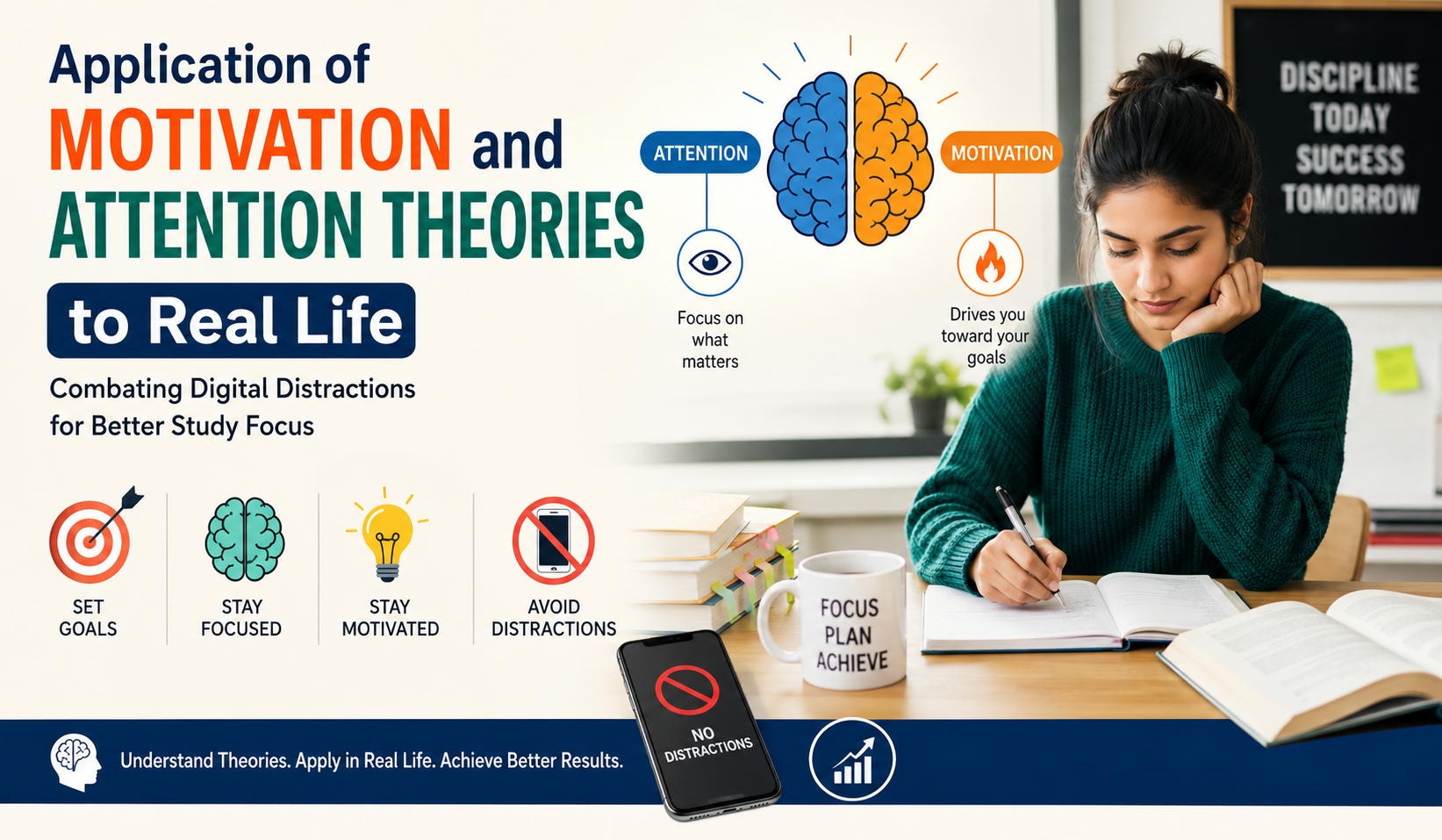
Attention and motivation theories are psychological frameworks that explain how we focus on tasks and sustain effort toward goals.
Attention Theory focuses on how the brain selectively processes information from the environment. Motivation Theory examines what drives behavior and sustains engagement despite obstacles.
Key Theories Explained:
- Selective Attention Theory: We can only process limited information at once; the brain filters relevant from irrelevant stimuli
- Cognitive Load Theory: Our working memory has limits; overloading it with tasks reduces learning efficiency
- Self-Determination Theory: Intrinsic motivation (internal drive) outperforms extrinsic motivation (external rewards)
- Goal-Setting Theory: Clear, challenging goals enhance focus and performance
These theories directly address the challenge of digital distractions learning explaining why notifications fragment attention and undermine academic success.
Understanding theories like attention, motivation, learning, and memory becomes much easier when you learn them with practical examples and expert guidance. At Confidante Psychology Academy, we simplify psychology through easy-to-understand courses, real-life applications, and exam-focused teaching for students, aspirants, and psychology enthusiasts.
The Real-Life Impact: Digital Distractions and Study Focus
How Digital Distractions Affect Learning
Phone distractions while studying represent one of the most significant barriers to academic achievement. Research shows that merely having a smartphone visible reduces cognitive capacity by 10-15%.
Key statistics on digital distractions:
- Students check phones every 4-8 minutes during study sessions
- Social media impact on academic performance correlates with 20-30% lower GPA in heavy users
- Attention span reduction has decreased from 12 seconds (2000s) to 8 seconds today
- Switching between tasks costs 23 minutes of refocus time
Understanding Attention Fragmentation
Attention fragmentation and context switching occur when your brain rapidly alternates between multiple tasks or stimuli. Each switch exhausts mental resources, reducing overall productivity by up to 40%.
Example: Checking Instagram while reading textbooks doesn’t just add 5 minutes it resets your focus, requiring an additional 23 minutes to regain full concentration.
Applying Motivation Theory to Study Focus Strategies
1.Intrinsic vs. Extrinsic Motivation
According to Self-Determination Theory, study motivation techniques work best when rooted in intrinsic motivation.
| Aspect | Intrinsic Motivation | Extrinsic Motivation |
| Source | Internal drive, curiosity, mastery | External rewards, grades, fear |
| Sustainability | Long-term, persistent | Short-term, diminishing |
| Impact on Learning | Deeper understanding, better retention | Surface learning, quick forgetting |
| Real-Life Example | Studying because you love the subject | Studying only for exam marks |
2. Goal-Setting for Academic Success
Study focus strategies improve dramatically with clear objectives.
Effective goal-setting framework:
- Set specific, measurable goals (e.g., “Complete Chapter 5 with 90% understanding”)
- Break large tasks into 25-50 minute focused blocks
- Establish consequences for interruption management
- Track progress visibly to maintain motivation
If topics like attention, motivation, behavior, cognition, and mental health fascinate you, our Clinical Psychology Course is the perfect next step
Managing Phone Distractions While Studying: Practical Solutions
Strategy 1: Environment Design
Your physical space directly influences digital distractions study focus.
Key interventions:
- Place phone in another room (not just silent mode)
- Use website blockers (Cold Turkey, Freedom) to restrict social media access
- Create a dedicated study zone free from notifications
- Use “Do Not Disturb” mode on all devices
Strategy 2: The Pomodoro Technique Applied to Attention Theory
This technique directly addresses attention span reduction by aligning study sessions with natural attention cycles.
How it works:
- Study for 25 minutes with complete focus
- Take a 5-minute break (no screens)
- After 4 cycles, take a 15-30 minute break
- Repeat
Why it works: Cognitive Load Theory shows our attention peaks at 20-30 minutes; structured breaks prevent mental fatigue.
Strategy 3: Interruption Management Protocols
Interruption management requires deliberate system design to prevent context switching losses.
Implementation steps:
- Batch-check emails/messages at specific times (10am, 2pm, 4pm only)
- Use auto-reply: “I respond to messages at scheduled times”
- Inform contacts of your study schedule
- Create notification rules: only urgent contacts bypass Do Not Disturb
You May Also Like To Read : Topic-Wise PYQ Analysis of Psychology Optional UPSC
The Psychology Behind Digital Distractions and Academic Performance
Social Media Impact on Academic Performance
Social media impact on academic performance operates through multiple psychological pathways:
- Reward-Seeking Behavior: Apps use variable reinforcement schedules (notifications unpredictably appearing) that trigger dopamine release, creating addiction patterns similar to gambling
- FOMO (Fear of Missing Out): Anxiety-driven checking reduces sustained attention and increases anxiety levels
- Cognitive Depletion: Each notification depletes willpower reserves, reducing impulse control over subsequent distractions
Why Attention Fragmentation Persists
Your brain develops “attention habits.” Each time you check your phone while studying, you reinforce the neural pathway linking study anxiety to phone-checking relief.
Breaking this cycle requires:
- 2-3 weeks of consistent interruption-free study (to rewire neural pathways)
- Replacing the distraction habit with a positive alternative (stretching, water break)
- Gradual smartphone reintroduction as study skills strengthen
Implementing Attention and Motivation Theories: Step-by-Step Action Plan
Week 1: Awareness Phase
- Track how often you experience phone distractions while studying
- Identify triggers for social media urges
- Establish baseline study quality/duration
Week 2-3: Environmental Setup
- Implement phone removal protocol
- Install website blockers for social media
- Establish interruption management system
Week 4: Skill Building
- Practice Pomodoro Technique daily
- Reframe goals toward intrinsic motivation
- Begin mindfulness meditation (5-10 minutes daily) to strengthen attention control
Week 5+: Sustainability
- Monitor improvements in study focus and academic performance
- Adjust strategies based on personal preferences
- Gradually reintroduce technology as focus skills solidify
Expert Perspective: Dr. Aarti
Managing digital distractions learning and maintaining study focus strategies requires understanding both cognitive science and practical psychology. Dr. Aarti a leading behavioral psychologist, emphasizes that attention and motivation theories aren’t abstract concepts but actionable frameworks for real-world improvement.
“Digital distractions aren’t willpower failures,” Dr. Aarti explains. “They’re predictable responses to how apps are designed. Understanding attention theory gives you the tools to outsmart both technology and your brain’s reward circuits.”
Measuring Success: Metrics That Matter
Track these indicators to measure improvement in study focus strategies:
- Study duration: Increase uninterrupted study blocks
- Quality metrics: Comprehension tests after study sessions
- Distraction count: Reduce phone checks per hour
- Academic performance: Monitor GPA or assignment scores
- Subjective focus: Rate concentration on 1-10 scale
Continue Reading : Essay Writing Strategy for UPSC 2026: Score High Marks
Common Questions
1. Can I completely eliminate digital distractions?
No.nor should you. The goal is strategic technology use. Apply interruption management during focused work; allow flexible access during breaks.
2. How long until study focus improves?
Most people notice 20-30% improvement within 2-3 weeks of consistent interruption-free study. Significant cognitive changes require 6-8 weeks.
3. Is phone addiction real?
Yes. Social media uses variable reward schedules identical to gambling mechanisms, triggering genuine dopamine-seeking behavior requiring deliberate rewiring.
Conclusion
Application of attention and motivation theories to real life transforms abstract psychology into concrete academic improvement. By understanding how digital distractions fragment focus and learning, and applying evidence-based study motivation techniques, you reclaim control over your attention.
The battle against phone distractions while studying isn’t about willpower it’s about leveraging cognitive science, strategic environment design, and intrinsic motivation alignment.