
What OCD Thoughts Actually Are
OCD doesn’t mean you’re obsessed with organization. What it really means is your brain gets stuck playing the same distressing songs on repeat unwanted thoughts, disturbing images, or nagging urges that won’t leave you alone. These aren’t things you want to think about. They just show up, uninvited, and drag anxiety along with them. Most people with OCD try to bury these thoughts with rituals (endless checking, excessive washing, constant reassurance) hoping to feel better.
Why You’re Here
You know how exhausting this is. A random worry about germs sends you scrubbing your hands raw. A fleeting thought that you might hurt someone transforms into hours of mental torture. A nagging feeling that something isn’t “just right” forces you to rearrange the same items over and over.
The worst part? Fighting harder against these thoughts usually backfires spectacularly. The more you wrestle with them, the tighter they grip you. Here’s what actually works: strategies based on real clinical psychology specifically Cognitive Behavioral Therapy and a technique called Exposure and Response Prevention. These aren’t quick fixes, but they address the actual problem, not just the symptoms.
Want to understand mental health conditions and psychological concepts in greater depth? Explore our Clinical Psychology Short-Term Course and strengthen your foundational knowledge of clinical psychology.
Strategy 1: See the Cycle for What It Is
The Pattern Nobody Tells You About
OCD operates like this: something triggers you → your brain produces an anxious thought → you feel panicked → you perform some kind of safety behavior → you get temporary relief → your brain learns this pattern.
The thing is, intrusive thoughts are normal. Most people have bizarre, unwanted thoughts every day. The difference? Healthy people shrug and move on. People with OCD interpret the thought as dangerous and feel compelled to act on it.
Here’s the problem: when you perform a compulsion and feel better, your brain draws the wrong conclusion. It decides the thought was genuinely threatening and you just narrowly avoided disaster by doing the ritual. This trains your brain to view the thought as a real danger signal.
Breaking Free from the Loop
Pay attention to when you’re caught in this pattern. Really notice it. When you catch yourself, try this: label it simply. “That’s my OCD, not me.” This tiny shift changes everything. You’re no longer fighting for your life against a genuine threat. You’re noticing a mental glitch.
Strategy 2: Face It Head-On Without Escaping (ERP)
Why Avoidance Makes Everything Worse
Exposure and Response Prevention or ERP is the actual gold standard for treating OCD. It sounds simple but it’s not easy. You deliberately face whatever triggers you, and then you resist the urge to perform your usual safety ritual.
The magic happens here: when you sit with the discomfort and don’t do the compulsion, your anxiety eventually decreases on its own. Your brain figures out that the bad thing you feared didn’t actually happen. You didn’t get sick from the “contaminated” object. You didn’t hurt anyone by having a harmful thought. The thought just… faded away.
How to Actually Do This
Say you’re terrified of contamination and wash your hands constantly. In ERP, you’d touch something you perceive as dirty, sit with that disgusting feeling, and not wash your hands. Your anxiety will spike. It’ll feel unbearable. But if you stay with it, the anxiety naturally drops. That’s the learning happening your brain’s survival instinct recalibrating.
Evidence backs this up hard. Most people see real improvement within two to three months of consistent ERP work.
Take Your Psychology Knowledge Further
From understanding human behaviour to exploring mental health concepts, build a stronger foundation in psychology with our Complete Psychology Master Course.
Strategy 3: Stop Treating Thoughts Like Facts
Cognitive Defusion: The Perspective Shift
Cognitive defusion doesn’t mean fighting your thoughts or pretending they don’t exist. It means you stop treating them like truth.
Compare these two responses to the same thought:
“I’m a terrible person” (you’ve fused with the thought)
versus
“I’m having the thought that I’m a terrible person” (you’re observing it as a mental event)
That second version? That’s the shift. You’re not the thought. You’re noticing the thought. Huge difference.
Practical Tricks That Work
Try these when an obsessive thought shows up:
- Name it out loud: “There goes my OCD again.”
- Sing the thought to something ridiculous like the tune of “Happy Birthday.” Suddenly it sounds less threatening.
- Repeat the problematic word until it loses all meaning. Say “contamination” fifty times fast and notice how it stops sounding like anything real.
- Watch the thought float by like a cloud in the sky. Acknowledge it’s there, then let it pass.
These aren’t mind games. They’re actually retraining how your brain relates to the content of your thoughts.
Strategy 4: Become Comfortable With Not Knowing
The Certainty Trap
People with OCD are often trapped by an impossible demand: be 100% certain. Certain you didn’t lock the door wrong. Certain you didn’t accidentally say something offensive. Certain you won’t act on that violent thought. Certain, certain, certain.
Here’s the problem: absolute certainty is a fiction. Nobody gets it. You can check the door five times and still technically not be 100% sure. That’s not an OCD problem that’s the human condition.
Living With “Good Enough”
Instead of chasing perfect certainty, practice living with reasonable doubt. Make a decision and stick with it. Accept that maybe something bad could happen and that you’d survive it anyway. Tolerate “I’m not completely sure” as a valid answer.
This actually works backward from how it seems like it should. The moment you stop demanding certainty, OCD loses its biggest lever. Accepting uncertainty is more powerful than any amount of checking or reassurance ever was.
Strategy 5: Stop the Safety Behaviors
Why Your Rituals Keep Trapping You
Compulsions feel necessary. They feel like you’re preventing disaster. But here’s the truth: they’re fuel. Every time you seek reassurance, perform a ritual, clean excessively, check repeatedly, or ruminate endlessly, you’re reinforcing the idea that the thought was dangerous and required action.
You probably already know this doesn’t work long-term. The relief lasts maybe minutes before the thought comes back. But you do it anyway because not doing it feels impossible.
Start Small, Build Momentum
You don’t need to quit all your compulsions at once. That’s setting yourself up to fail. Instead, pick one. A minor ritual or reassurance-seeking behavior you perform regularly. Deliberately skip it for a defined period maybe just an hour at first. Notice your anxiety rise. Notice it eventually fall without you doing anything. That’s the proof your brain needs.
Once you succeed with that one, move to the next. Building from smaller wins creates actual progress.
Strategy 6: Anchor Yourself to Right Now
OCD Lives in Hypothetical Futures
OCD doesn’t keep you present. It drags you into nightmare scenarios that haven’t happened and probably won’t. Mindfulness pulls you back to what’s actually occurring.
The 5-4-3-2-1 Grounding Technique
When an obsessive spiral starts, try this:
- Spot 5 things you can actually see
- Touch 4 things in your immediate environment
- Listen for 3 distinct sounds
- Find 2 things you can smell
- Identify 1 thing you can taste
This sounds simple because it is simple. But it interrupts the anxiety spiral by reconnecting you to sensory reality instead of the horror show in your head.
Strategy 7: Get Professional Help
Why Going It Alone Often Backfires
These strategies help, but OCD often needs professional intervention. A therapist trained in ERP and CBT will:
- Identify your specific OCD flavor (contamination, harm fears, perfectionism, religious scrupulosity, etc.)
- Build an exposure hierarchy tailored to your triggers
- Coach you through the scary parts
- Make sure you’re not accidentally enabling compulsions through subtle safety behaviors
A lot of people attempt self-directed ERP, but they end up reinforcing the problem without realizing it. Professional guidance cuts through that.
Practical Tips That Actually Help
- When OCD thoughts appear, think “not helpful” instead of fighting them. Acknowledge it and redirect your attention.
- Write down your triggers, the thoughts that follow, your anxiety level, and what you did about it. Patterns emerge fast.
- Stop asking people for reassurance. The temporary comfort strengthens OCD’s grip.
- Create a ladder of your triggers ranked by how much anxiety they cause. Start with the ones at 4 or 5 intensity, not 10s.
- Be kind to yourself. OCD is a real condition, not a personality flaw.
- Don’t spend hours researching symptoms online or seeking certainty. That’s just a compulsion in disguise.
Mistakes That Usually Happen
Don’t fight your thoughts directly. Counterintuitively, acceptance works better than resistance. Asking for reassurance over and over feels good for five minutes, then makes everything worse. Avoiding your triggers keeps them in power. Facing them takes that power away. Expecting the thoughts to vanish completely is unrealistic. The goal is reducing how much they bother you, not elimination. Self-directed ERP without guidance can backfire. Bad technique can create new compulsions or make anxiety worse.
Common OCD Patterns & How to Handle Each
| Type | What It Looks Like | What Actually Helps |
| Contamination Fears | Convinced germs will destroy you, endless washing | Tolerate discomfort without washing beyond normal |
| Harm Obsessions | Terrified you’ll hurt someone, constant reassurance-seeking | Accept the thought; having it doesn’t make you do it |
| Religious Scrupulosity | Convinced you’ve blasphemed or committed moral sins | Resist the urge to confess or seek reassurance repeatedly |
| Unwanted Sexual Thoughts | Disturbing sexual images or urges you don’t want | Remember: thoughts aren’t desires and don’t define you |
| Everything Must Be Perfect | Things need to feel “just right” or organized precisely | Practice leaving things intentionally imperfect |
| Doubt and Checking | Endless uncertainty, constant verification | Accept doubt; stop seeking 100% certainty |
Questions People Actually Ask
1. Is OCD something you get over?
OCD is highly treatable between 60-80% of people see significant improvement. It doesn’t always disappear completely, but it becomes manageable. Many people get to a point where it’s more of an occasional annoyance than something that dominates their life.
2. Why do these thoughts feel so real and dangerous?
Your brain treats them as genuine threats. That’s the disorder. Therapy teaches you to recognize them as false alarms your threat-detection system misfiring. Over time, you learn to doubt the thought instead of doubting yourself.
3. Do you have to take medication?
Medication isn’t required for everyone. Therapy alone works for many people. But SSRIs combined with therapy tend to produce the best results, especially for moderate to severe OCD. Talk to a psychiatrist about what makes sense for your situation.
4. How long until you feel better?
Most people notice real changes within 8-12 weeks of consistent ERP. Significant symptom reduction usually takes 4-6 months. It’s not overnight, but it’s not years either.
5. What separates normal intrusive thoughts from OCD?
Everyone gets random strange thoughts. The difference: most people think something weird and move on. With OCD, the thought triggers serious anxiety and feels like it means something important. That’s when compulsions follow.
6. Why do compulsions make OCD worse instead of better?
Because they teach your brain that the threat was real. Every ritual reinforces the cycle. Breaking that pattern is central to recovery.
Want to Understand Your Thoughts Better?
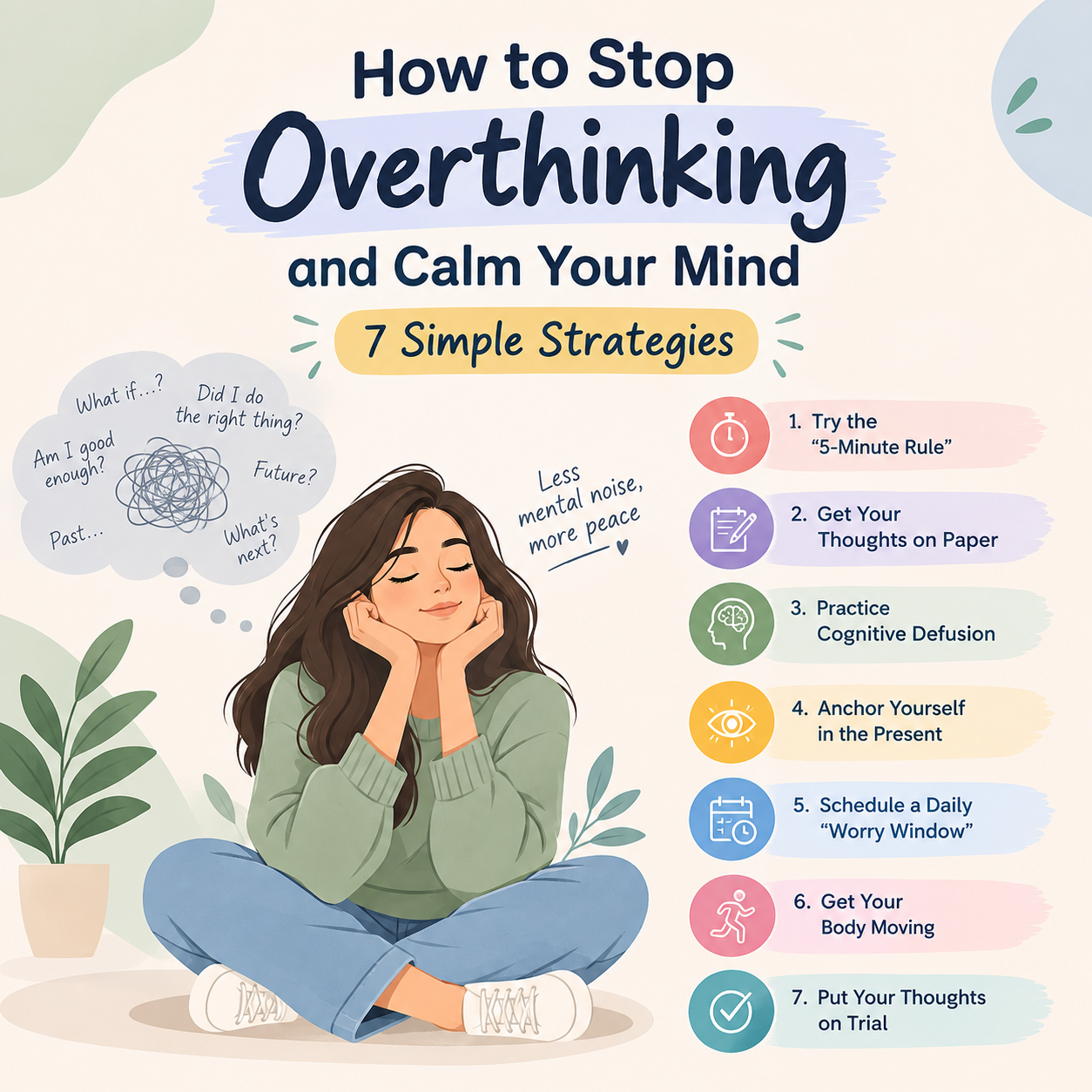
Read our guide on How to Stop Overthinking and Calm Your Mind: 7 Simple Strategies to discover practical ways to manage overthinking and support emotional well-being.
What Actually Matters
- OCD is treatable. The research is solid on this.
- Your brain’s threat-detection is misfiring, not your character.
- Facing discomfort breaks the cycle more effectively than any ritual does.
- Being uncertain is normal. Accepting it removes OCD’s power.
- Professional support cuts the recovery timeline significantly.
- Most people respond well to therapy. You’re not broken.
The Bigger Picture
OCD isn’t a reflection of who you are. It’s a glitch in how your nervous system processes threats.You don’t need perfect certainty or rituals to be safe. Those are the trap. Real recovery happens when you rewire your brain’s threat response through ERP and cognitive techniques. A therapist trained in this stuff will guide you through exposure work that actually changes neural pathways.
The path forward isn’t controlling your thoughts or eliminating them. It’s changing your relationship with them. When you stop fighting OCD and accept uncertainty instead, you get your mental space back.