Introduction
Many Psychology students ask, “Can I crack NET SET without coaching?” Yes. Coaching can provide structure, but it is not compulsory. A focused self-study plan offers flexibility and control over your pace.
UGC NET has two papers. Paper I tests teaching and research aptitude, while Paper II tests subject knowledge. The NTA bulletin specifies a three-hour computer-based test with 50 questions in Paper I and 100 in Paper II, totaling 300 marks. SET patterns can vary by state, so always check your latest state SET notification.
Is NET SET Possible Without Coaching?
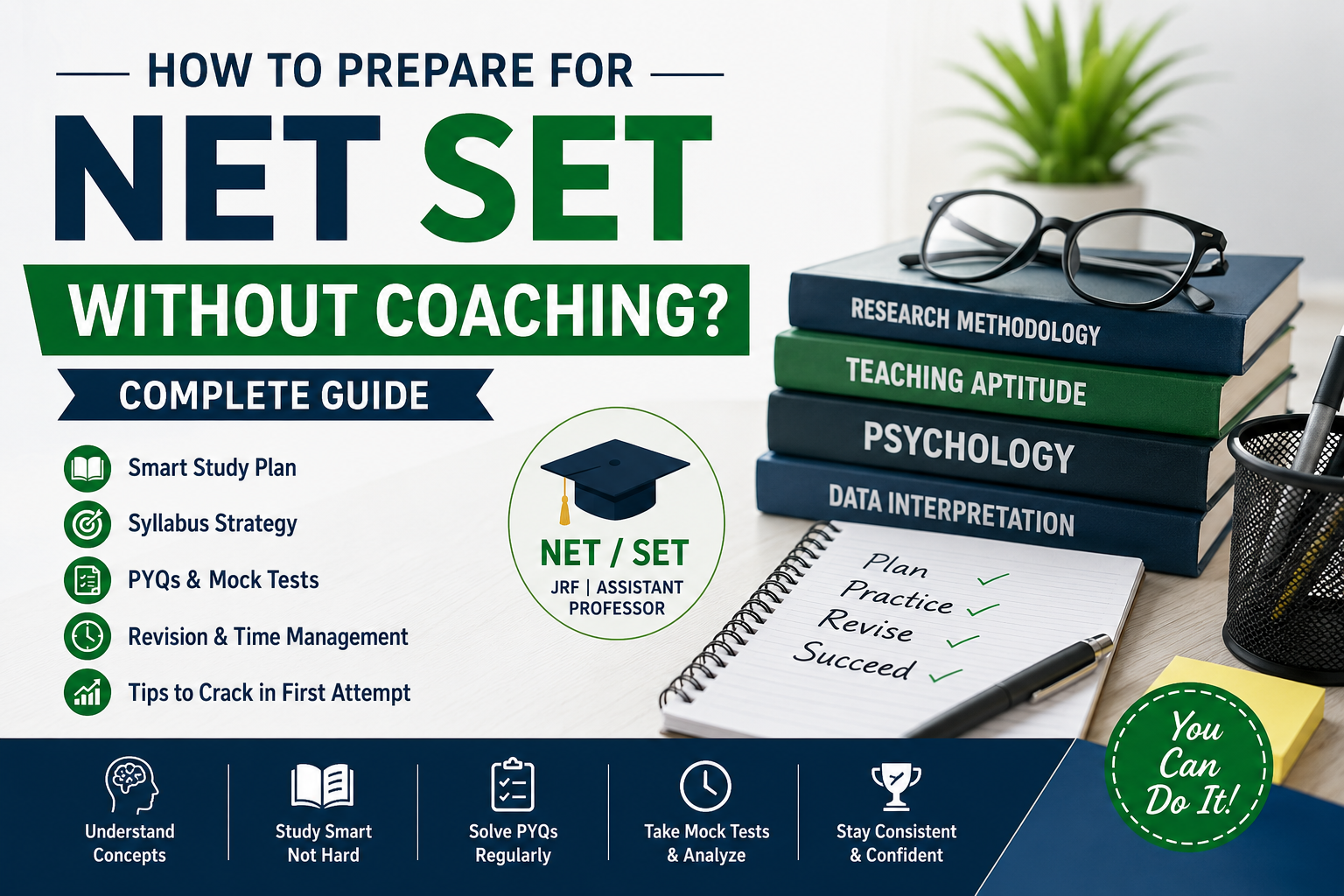
Yes, but self-study does not mean studying without a system. You must become your own planner, teacher, evaluator, and revision manager. The approach is simple: understand the syllabus, learn concepts, solve PYQs, analyze mistakes, revise, and test yourself regularly.
Build a strong foundation for UGC-NET & SET Psychology with structured, exam-focused learning.
👉 Start your Psychology preparation with Master Course – Part 1.
How to Prepare for NET SET Without Coaching: 7 Steps
1. Start With the Official Syllabus
Download the latest UGC NET syllabus and relevant SET syllabus. Divide topics into strong, average, and weak areas. Your syllabus should be your checklist. For Psychology, cover research methods, statistics, biological bases, learning, memory, cognition, personality, social psychology, development, testing, abnormal psychology, and applied psychology.
2. Build a Small Resource List
Self-study becomes difficult when students collect too many PDFs, playlists, books, notes, and test series. Choose limited, reliable resources. Use standard Psychology textbooks for concepts, one dependable Paper I resource, official syllabus documents, previous-year papers, and quality mock tests. Use free lectures for difficult topics, but keep videos secondary to active study.
3. Focus on Conceptual Clarity
NET SET Psychology is not only about memorization. Questions may test application, comparison, theory, or interpretation. For each major theory, learn the psychologist, central concept, assumptions, and application. For research methodology and statistics, understand what each method or test means, when it is used, and how results are interpreted.
4. Make PYQs Your Study Partner
Previous-year questions are essential. Solve them topic-wise first and full-length later. Classify mistakes as conceptual, factual, careless, or time-related. Maintain an error notebook. Revising mistakes is often more useful than repeatedly answering questions you already know.
5. Prepare Paper I and Paper II Together
Do not postpone Paper I until the final weeks. Divide your weekly schedule between teaching/research aptitude and Psychology.
A practical daily routine is:
- 2 hours: Psychology concepts
- 45 minutes: Paper I
- 45 minutes: PYQs or MCQs
- 30 minutes: Revision
- Weekly: One timed test plus analysis
If time is limited, shorten sessions but keep the structure.
Take your NET/SET Psychology preparation further with advanced concepts and exam-oriented practice.
👉 Continue your preparation with Master Course – Part 2.
6. Follow a 90-Day Plan
Days 1–30: Foundation
Complete major concepts, make short notes, and begin topic-wise PYQs. Prioritize understanding.
Days 31–60: Practice
Finish remaining units, increase MCQ practice, revise difficult concepts, and take regular mixed tests.
Days 61–90: Revision
Shift from learning to performance. Take full-length mocks, revise your error notebook, practise time management, and target weak areas.
7. Track Progress Weekly
Every Sunday, record units completed, PYQs attempted, mock score, accuracy, repeated mistakes, and topics needing revision.
If scores remain stagnant, change your study method instead of simply adding more hours.
Self-Study vs Coaching
| Factor | Self-Study | Coaching |
|---|---|---|
| Cost | Usually lower | Usually higher |
| Flexibility | High | Structured |
| Pace | Personal | Institute-led |
| Doubt support | Self-managed | Usually available |
| Accountability | Self-created | Often provided |
| Best for | Disciplined learners | Students needing structure |
Coaching and self-study are methods, not guarantees.
Common Mistakes to Avoid
Avoid collecting unlimited material, skipping Paper I, ignoring statistics, memorizing without understanding, delaying PYQs, taking mocks without analyzing them, and changing your strategy every few weeks. Track your own accuracy, recall, and mock performance instead of comparing yourself with others.
Can You Prepare While Studying or Working?
Yes. Instead of an unrealistic eight-hour timetable, use consistent study blocks. Three focused hours daily can produce meaningful progress when they include learning, practice, and revision. Focus on useful learning, not maximum study hours.
How Confidante Psychology Academy Can Help
Confidante Psychology Academy, founded by Dr. Arti Kandolkar, supports Psychology learners through structured teaching and competitive-exam preparation. Dr. Arti holds a PhD in Psychology and has extensive experience in competitive-exam teaching and mentoring. Even students choosing self-study may benefit from expert guidance for difficult concepts, PYQ patterns, preparation gaps, and exam strategy. Its Psychology-focused approach can complement independent preparation.
NET SET Self-Study Checklist
Before the exam:
- Complete the official syllabus
- Cover Paper I and Paper II
- Solve previous-year questions
- Revise short notes
- Maintain an error notebook
- Take timed mock tests
- Review weak areas
- Check the latest official notification
Final Takeaway
Preparing for NET SET without coaching is realistic when self-study is structured. Start with the syllabus, use limited quality resources, build conceptual clarity, practise PYQs, analyze mistakes, revise repeatedly, and measure progress through tests. Coaching can provide guidance, but consistency, smart practice, and disciplined self-study remain the core of successful preparation.