
Introduction
When it comes to UPSC Mains, it’s not just about what you know; it’s about how you present that knowledge within a tight timeframe and word limit. Developing strong answer writing skills is crucial for candidates, as it boosts clarity, structure, analytical thinking, and ultimately, your scoring potential.
Many aspirants are well-versed in the syllabus but find it challenging to transform their knowledge into high-scoring answers. With regular practice, a solid structure, and smart presentation techniques, you can significantly enhance your answer-writing skills for UPSC Mains.
In this guide, we’ll explore practical strategies, common pitfalls, daily practice routines, and expert tips to help you improve your answer-writing skills for UPSC Mains.
Why Are Answer Writing Skills Essential for UPSC Mains?
Answer writing skills are vital for UPSC Mains because the exam evaluates your analytical abilities, clarity of thought, and presentation skills rather than just memorization.
Strong answer writing enables you to:
- Clearly present your ideas
- Manage your time effectively
- Achieve higher scores
- Enhance the quality of your answers
- Cultivate multidimensional thinking
- Craft structured and balanced responses
Without adequate practice in answer writing for UPSC Mains, even the best preparation might not yield the marks you’re aiming for.
Master Answer Writing with Expert Guidance!
Join our UPSC/MPSC Psychology Optional Classes and learn how to write high-scoring answers with structured notes, test series, and mentorship.
How to Enhance Your Answer Writing Skills for UPSC Mains
1. Grasp the UPSC Mains Requirements
Before you start writing any answer, it’s essential to understand what UPSC is really asking.
Pay attention to:
- Directive words
- Core topic
- Keywords
- Word limit
- The specific demand of the question
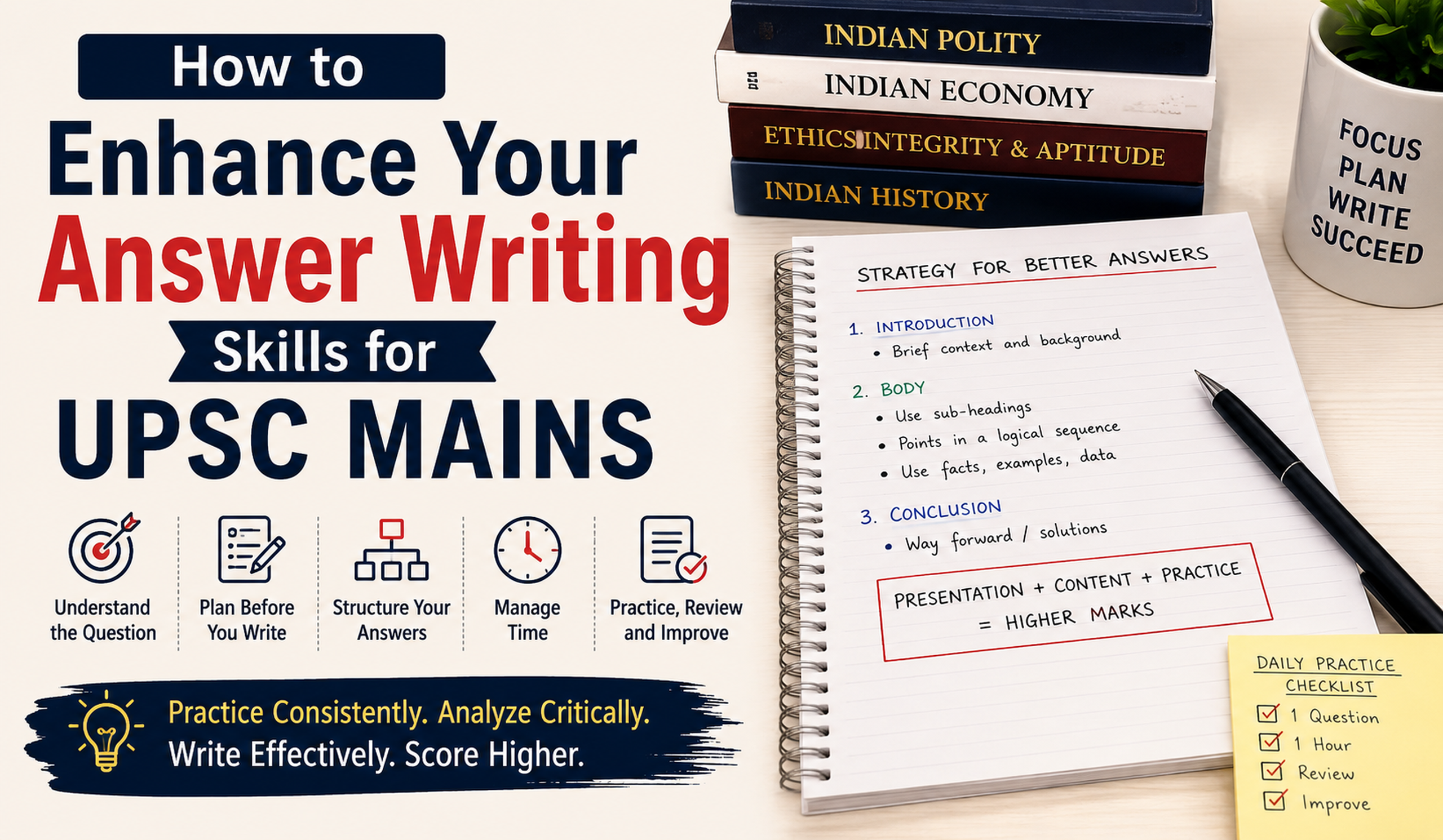
2. Follow the Ideal Answer Structure
Having a clear structure makes your answers easier to read and can lead to better scores.
Standard UPSC Answer Structure
Introduction
- Define the topic
- Provide recent context
- Incorporate data, reports, or facts
Body
- Main explanation
- Break it down into headings and subheadings
- Include examples, diagrams, and facts
Conclusion
- Wrap it up with a positive and balanced ending
- Add a way forward
- Consider it from a constitutional or ethical standpoint
Start Your Journey in Mental Health Practice!
Join our Clinical Psychology Internship Program and get hands-on learning experience guided by psychology professionals.
3. Practice Daily Answer Writing
If you want to sharpen your answer writing skills for the UPSC Mains, daily practice is your best bet.
Daily Practice Strategy
- Aim to write 2–3 answers each day
- Stick to time limits while practicing
- Use questions from previous years
- Analyze the answers of top scorers
- Regularly review your mistakes
Remember, consistency trumps writing a bunch of answers sporadically.
How Many Answers Should You Practice Daily for UPSC Mains?
For beginners, tackling 2–3 answers a day is ideal. If you’re at an intermediate level, you can ramp it up to 5–8 answers.
Focus on:
- Structure
- Clarity
- Relevance of content
- Time management
With regular practice, your speed and confidence in answer writing for the UPSC Mains will steadily improve.
4. Improve Introduction and Conclusion Writing
Introductions and conclusions are crucial because they create the first and last impression.
Strong Introduction Techniques
- Start with a definition
- Use data or reports
- Reference a constitutional article
- Link to current affairs
- Mention committee recommendations
Strong Conclusion Techniques
- End with a solution-oriented approach
- Maintain a positive tone
- Consider sustainable development
- Include an ethical perspective
- Reference government initiatives
5. Use Keywords and Important Terms
UPSC examiners skim through answers quickly, so highlighting keywords can really enhance readability.
Important Tips
- Underline key terms
- Use official government language
- Reference constitutional articles
- Mention committee names
- Include relevant schemes and reports
Incorporating the right keywords can significantly boost your answer writing skills for the UPSC Mains.
6. Add Diagrams, Flowcharts, and Maps
Visual presentation makes answers attractive and easier to understand.
Useful Visual Elements
- Flowcharts
- Mind maps
- India maps
- Cycle diagrams
- Tables
- Cause-effect charts
Simple diagrams save time and improve presentation quality.
Are Flowcharts Important in UPSC Mains Answers?
Absolutely! Flowcharts can really enhance your presentation and make complex topics easier to digest.
Use flowcharts for:
- Governance topics
- Economy
- Environment
- Internal security
- Ethics case studies
Flowcharts should always be simple and relevant.
7. Focus on Multidimensional Analysis
The UPSC is looking for answers that are both balanced and analytical.
Include multiple dimensions:
- Social
- Economic
- Political
- Ethical
- Environmental
- International
- Technological
Crafting multidimensional answers can help improve your UPSC Mains score.
8. Improve Time Management
A lot of aspirants struggle to finish their papers on time.
Tips to Boost Writing Speed
- Practice with timed mock tests
- Skip unnecessary details
- Keep sentences short
- Write in bullet points
- Ensure clear handwriting
How Can You Write Faster in UPSC Mains?
To speed up your writing during the UPSC Mains:
Follow these strategies:
- Engage in daily timed writing practice
- Improve handwriting speed
- Utilize flowcharts and bullet points
- Don’t overthink responses
- Stick to a consistent structure
With regular practice, your speed will gradually improve.
9. Analyze Topper Answer Copies
Looking at topper copies can give aspirants valuable insights into what the UPSC expects.
Pay close attention to:
- Structure
- Presentation
- Use of facts
- Introduction style
- Diagram usage
- Conclusion techniques
Do not blindly copy toppers. Develop your own writing style.
10. Use Current Affairs in Answers
Incorporating current affairs enriches answers and improves relevance.
Include:
- Government schemes
- Supreme Court judgments
- Reports and indices
- International developments
- Committee recommendations
Current affairs integration strengthens answer writing skills for UPSC Mains.
Common Mistakes in UPSC Mains Answer Writing
Avoid These Mistakes
- Writing off-topic content
- Overlooking directive words
- Lacking a clear structure
- Forgetting the conclusion
- Using too many paragraphs
- Not providing examples or facts
- Exceeding the word limit
- Poor handwriting
Avoiding these mistakes improves answer quality significantly.
Best Sources for UPSC Mains Answer Writing Practice
Recommended Sources
- Previous Year Questions
- NCERT Books
- Standard Reference Books
- Daily Newspaper Editorials
- Monthly Current Affairs Magazines
- Copies from UPSC Toppers
- Test Series
High-quality content is key to enhancing answer writing skills for UPSC Mains.
Daily Routine to Improve Answer Writing Skills for UPSC Mains
Morning
- Read the newspaper
- Take brief notes
Afternoon
- Study static subjects
Evening
- Practice writing answers
- Review mistakes
Night
- Revise key terms and facts
A disciplined routine can consistently improve answer writing skills for UPSC Mains.
Final Thoughts
Enhancing your answer writing skills for the UPSC Mains is all about patience, consistency, and smart practice. Just having knowledge isn’t enough to ace the UPSC Mains.
What truly matters is your ability to express ideas clearly, analytically, and within the given time limit.
Start with small steps, practice daily, learn from your mistakes, and keep refining your structure and presentation. Over time, your answer writing skills for the UPSC Mains will become quicker, sharper, and more effective.
Regular answer writing practice for UPSC Mains is one of the best strategies for achieving high marks and improving your final rank.