
Psychometric testing is a scientific approach designed to assess mental abilities, personality traits, behaviors, and other psychological characteristics. It is commonly utilized in fields like education, recruitment, psychology, and career counseling to support informed, objective decisions based on data.
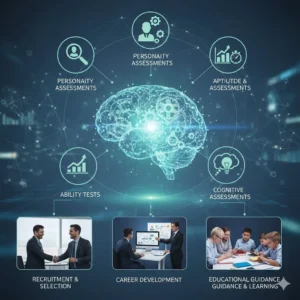
What Is Psychometric Testing?
Psychometric testing refers to standardized psychological assessments designed to measure various aspects of an individual, including intelligence, aptitude, personality traits, emotional intelligence, and skills.
These tests rely on validated questions and standardized scoring systems to ensure accuracy, reliability, and fairness. By utilizing measurable psychological data, psychometric testing enables objective comparison between individuals.
How Does Psychometric Testing Work?
Psychometric testing involves the use of structured assessments to evaluate specific psychological traits within a controlled environment.
Key Steps in Psychometric Testing:
- Selecting the appropriate test based on its intended purpose, such as career guidance, recruitment, or clinical
- Administering the test under standardized conditions, either online or
- Scoring the results by comparing them against established norms and
- Having qualified professionals interpret the findings.
- Making informed decisions based on data-driven
Types of Psychometric Tests
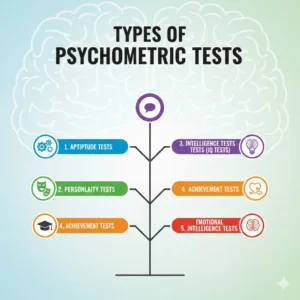
Psychometric tests are available in various types, each designed to serve a specific purpose.
1. Aptitude Tests
Measure the capability for a relatively specific task or type of skill; aptitude tests are, in effect, a narrow form of ability testing. These tests gauge your problem-solving skills, numerical ability, verbal reasoning, and logical thinking.
2. Personality Tests
Measure the traits, qualities, or behaviors that determine a person’s individuality; such tests include checklists, inventories, and projective techniques.
3. Intelligence Tests (IQ Tests)
Measure an individual’s ability in relatively global areas such as verbal comprehension, perceptual organization, or reasoning and thereby help determine potential for scholastic work or certain occupations.
4. Achievement Tests
Measure a person’s degree of learning, success, or accomplishment in a subject or task.
5. Emotional Intelligence Tests
These assessments evaluate emotional awareness, empathy, stress management, and interpersonal effectiveness..
What Are the Main Applications of Psychometric Testing?
Psychometric testing is highly versatile and is widely used across multiple fields due to its objective nature and its ability to predict performance and outcomes.
Applications of Psychometric Testing
- Recruitment and talent assessment
- Career guidance and counselling
- Educational assessment
- Clinical psychology and diagnosis
- Employee training and development
- Leadership and management evaluation
Psychometric Testing in Recruitment and Human Resources
Organizations increasingly rely on psychometric testing to enhance the accuracy and effectiveness of their hiring processes.
Reasons Companies Use Psychometric Tests
- To predict job performance
- To reduce hiring bias
- To assess cultural alignment
- To evaluate cognitive and behavioural competencies
Psychometric Testing in Education
In the field of education, psychometric testing serves as a valuable tool for assessing learning abilities, academic potential, and personal strengths.
Educational Applications:
- Identifying learning challenges
- Assisting in subject selection
- Analyzing academic potential
- Assessing eligibility for scholarships and entrance examinations
Psychometric Testing in Psychology and Mental Health
Psychometric testing plays a crucial role in the domains of clinical psychology and counseling by providing structured and evidence-based assessments.
Clinical Applications
- Diagnosing mental health conditions
- Evaluating personality disorders
- Gauging emotional well-being
- Monitoring therapeutic progress
Psychometric Testing for Career Guidance
Career counselors utilize psychometric testing to guide individuals toward career paths that align with their abilities, interests, and personality traits.
Benefits for Career Guidance :
- Identifies personal interests and strengths
- Aligns personality traits with suitable career options
- Reduces uncertainty in career decision-making
- Enhances confidence in making decisions
Advantages of Psychometric Testing
Psychometric testing offers numerous benefits across a wide range of professional and academic settings.
Key Advantages
- Provides an objective and unbiased evaluation
- Produces scientifically validated results
- Offers predictive accuracy
- Supports efficient decision-making
- Ensures fair and consistent comparisons among individuals
Limitations of Psychometric Testing
Despite its many advantages, psychometric testing also has certain limitations that should be considered.
Common Limitations
- Requires skilled and professional interpretation
- May exhibit cultural biases if not carefully designed
- Should not replace interviews or holistic assessments
- Results can be influenced by performance anxiety
How Reliable Is Psychometric Testing?
Psychometric testing is considered reliable when assessments are properly standardized, scientifically validated, and professionally administered.
- Reliability depends on:
- Test design
- Appropriateness of Norm groups
- Accurate scoring procedures
- Qualified and ethical interpretation
Future Scope of Psychometric Testing
The future of psychometric testing is evolving rapidly with the integration of artificial intelligence(AI), data analytics, and digital platforms.
Emerging Trends
- Assessments powered by AI
- Online adaptive testing methods
- Gamified psychometric evaluations
- Predictive analytics for workforce and talent planning
FAQs
1. What is psychometric testing used for?
Psychometric testing is used to assess intelligence, aptitude, personality traits, and behavior patterns. It helps in recruitment, education, career guidance, and psychological diagnosis by providing objective, data-based insights for informed decision-making.
2. Are psychometric tests accurate?
Yes, psychometric tests are accurate when they are scientifically validated and administered under standardized conditions. Their reliability depends on test design, standardization, and professional interpretation.
3. Who can take psychometric tests?
Psychometric tests can be taken by Students, job seekers, employees, and individuals seeking career or psychological guidance. suitablility depends on the specific and age group.
4. Are psychometric tests limited for psychology?
No, psychometric testing is used beyond psychology. It is widely applied in HR, education, corporate training, leadership development, and career counselling.
5. Can psychometric testing predict job success?
Psychometric testing can effectively predict job performance by assessing cognitive abilities, personality traits, and behavioural fit, making it a valuable tool recruitment and talent management..
6. Is psychometric testing mandatory in recruitment?
Psychometric testing is not mandatory, however, it is increasingly preferred by organizations to ensure fair, unbiased, and data-driven hiring decisions.
