
UPSC Psychology Optional Syllabus Explained Simply
For many UPSC aspirants, the word optional subject often leads to confusion. Questions such as Which subject is scoring? Which one is manageable? And most importantly, which one can actually be understood without stress? commonly arise. Among the various options, psychology has gradually become a popular choice.However , many students hesitate because they feel the syllabus might be complicated.
This guide , UPSC Psychology Optional Syllabus Explained Simply, aims to provide a clear, structured, and practical understanding of the syllabus.whether you are a beginner or from a non-psychology background, this overview will help you understand the UPSC Psychology Optional Syllabus in an accessible and systematic manner.
Why Understanding the UPSC Psychology Optional Syllabus Matters
Before buying reference books or joining coaching, the first step should always be understanding the syllabus. Many aspirants overlook this step and later experience confusion during preparation .When clearly understand the Psychology Optional Syllabus UPSC, everything becomes more organised.
A clear understanding helps you:
- Know what to study and what to skip
- Avoid unnecessary overload
- Plan your preparation time effectively
- Build confidence through clarity
Psychology becomes much easier when you study it with direction instead of fear.
What Is the UPSC Psychology Optional About?
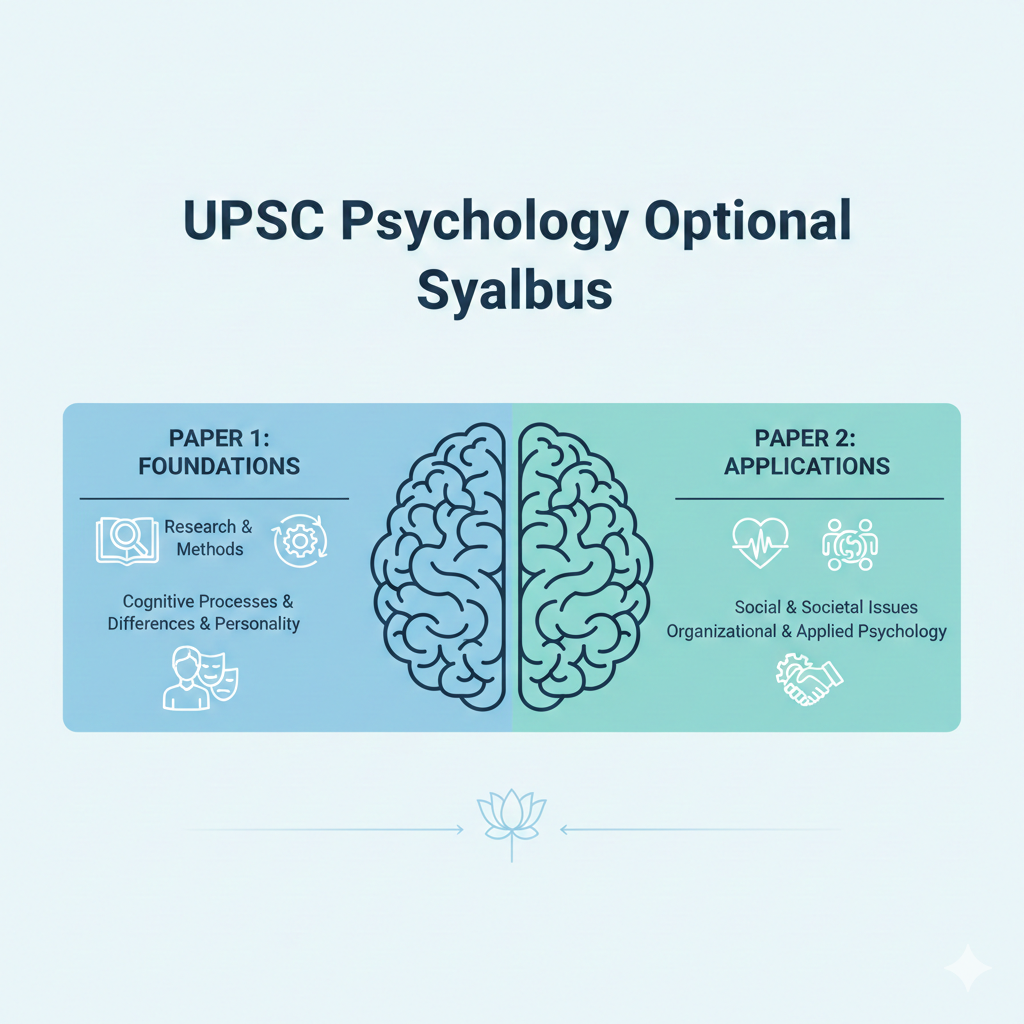
The UPSC Psychology Optional has two papers. Both papers are designed to test how well you understand human behaviour and how you apply psychological concepts.
- Paper 1 focuses on basic concepts and foundations
- Paper 2 focuses on applied psychology and Indian context
Once this structure is clearly understood, the syllabus appears more organized and less overwhelming.
UPSC Psychology Optional Syllabus Explained Simply – Paper 1
Paper l establishes the foundational framework. Even candidates without prior academic exposure to psychology can understand this paper, as it begins with fundamental concepts.
Start Your Learning Journey https://drartipsych.com/upsc-mpsc-psychology-optional-course/
Introduction to Psychology
This section introduces core ideas, including:
- The definition and scope of psychology
- The historical development of psychology as a scientific discipline
- Major schools of thought and theoretical perspectives
It lays the conceptual foundation for the entire syllabus and is particularly accessible for beginners.
psychology can understand this paper, as it begins with fundamental concepts.
It lays the conceptual foundation for the entire syllabus and is particularly accessible for beginners.
Research Methods and Statistics
This section sounds technical, but it is manageable when studied step by step. It covers:
- The principles of psychological research
- Basic research methodologies
- Fundamental statistical concepts
With examples, this section becomes logical rather than intimidating
Biological Basis of Behaviour
Here, psychology connects with biology.which includes::
- The structure and functioning of the brain and nervous system
- The role of hormones in regulating behaviour
- Genetic influences on psychological processes
This foundational knowledge helps aspirants understand the biological mechanisms underlying human thoughts, emotions, and actions.
Learning, Memory, and Intelligence
These topics feel very relatable. You learn about:
- The principles and theories of learning
- The structure and functioning of memory
- Different types of intelligence
These areas are easy to explain with real-life examples and are often scoring.
Motivation, Emotion, and Personality
This section focuses on:
- The determinants of human behaviour
- Theories of emotion and emotional processes
- Major theories of personalit
since these topics connect directly with daily life, answers become more natural and effective.
Discover More Insights in Our Related Blog https://drartipsych.com/how-do-i-choose-a-good-psychology-college-a-simple-guide-for-students/
UPSC Psychology Optional Syllabus Explained Simply – Paper ll
Paper ll is more application-oriented and closely connected to society and administration.
Psychological Measurement and Testing
This section introduces the scientific methods used to assess psychological attributes. It includes:
- Principles of Psychological testing
- Intelligence and aptitude testing
- Concepts of Reliability and validity
This section helps you understand how standardized assessments are developed and applied in educational, clinical, and organizational settings.
Social, Industrial, and Organisational Psychology
This area focuses on behaviour within social and professional environments. Topics include:
- Group and social behaviour
- Leadership theories and motivation processes
- Attitudes and social influence
These topics are extremely relevant for governance and administration and public policy, making them highly applicable for civil services preparation.
Clinical Psychology
This section introduces fundamental concepts related to mental health and psychological well-being. It covers:
- Basic Mental health concepts
- Stress and coping mechanisms
- An overview of Psychological disorders
It helps aspirants understand mental health issues faced by society today.
Community Psychology and Social Change
This area integrates psychological principles with social development and public welfare. It includes:
- Analysis of Social problems
- Role of psychology in community development
- Intervention and prevention strategies
This part overlaps with GS and Ethics papers.
UPSC Psychology Optional Syllabus for Beginners – Is It Manageable?
Many aspirants question whether the UPSC psychology optional syllabus is suitable for beginners .In practice, psychology is one of the more beginner-friendly optionals.
Beginners often find psychology manageable because
- Concepts start from basics
- Less memorisation, more understanding
- Human behaviour is relatable and observable
- Logical flow of topics
With consistency, even first-time learners can master it.
Psychology Optional Syllabus Explained in a Practical Way
When the psychology optional syllabus explained properly, preparation becomes smoother. The key is:
- Understanding concepts clearly
- Using real-life examples
- Connecting theory with current issues
- Practising answer writing regularly
Psychology rewards clarity, not complexity.
How Much Time Is Required to Complete the Syllabus?
On average:
- Four to five months for understanding the syllabus
- One to two additional months for revision and practice
Since the UPSC Psychology Optional Syllabus does not change frequently, revision becomes easier with time.
Why Psychology Optional Makes Sense Beyond the Exam
Psychology is not just about clearing UPSC. It helps you:
- Develop greater self-awareness
- Manage stress during preparation
- Enhance communication and interpersonal skills
- Cultivate empathy and emotional sensitivity
Psychology helps individuals make better decisions and understand people better, useful even after exams .
Conclusion
When seen clearly, the UPSC Psychology Optional Syllabus is straightforward. It’s well-organized, easy to follow, and useful.
For beginners especially, an easy explanation of UPSC psychology optional syllabus removes fear and builds confidence. With the right approach and regular practice, psychology can become one of your strongest optional subjects.
FAQs – UPSC Psychology Optional Syllabus
Q1.Is the UPSC Psychology Optional syllabus suitable for beginners?
Yes. The syllabus begins with foundational concepts and can be understood with proper guidance.
Q2.Is a background in psychology necessary to choose this optional?
No. Many non-psychology students perform very well in UPSC Psychology Optional.
Q3.How much time is required to complete the syllabus?
Around 5–6 months with consistent study and revision.
Q4.Is UPSC Psychology Optional considered scoring?
Yes, the subject can be scoring when answers are clear, structured, and supported with examples.
Q5.Does studying psychology help in the UPSC interview?
Absolutely. It improves self-awareness, communication, and emotional balance,aof which are valuable during the personality test.
